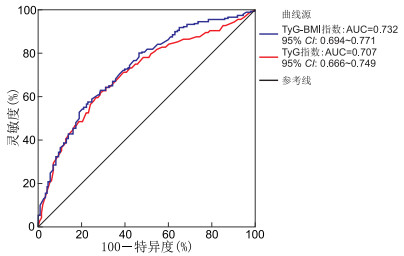
| Citation: | DAI Qingyun, WU Yan, GUO Qinhao, LI Lei, WANG Zhen, QI Jianjun. Comparison of the predictive value of the TyG index and related indices for lean non-alcoholic fatty liver disease[J]. Chinese Journal of General Practice, 2025, 23(11): 1866-1868. doi: 10.16766/j.cnki.issn.1674-4152.004247

|

| [1] |
GUO X Y, YIN X Z, LIU Z J, et al. Non-alcoholic fatty liver disease (NAFLD) pathogenesis and natural products for prevention and treatment[J]. Int J Mol Sci, 2022, 23(24): 15489. DOI: 10.3390/ijms232415489.
|
| [2] |
KUCHAY M S, MARTÍNEZ-MONTORO J I, CHOUDHARY N S, et al. Non-Alcoholic fatty liver disease in lean and non-obese individuals: current and future challenges[J]. Biomedicines, 2021, 9(10): 1346. DOI: 10.3390/biomedicines9101346.
|
| [3] |
KIM Y, HAN E, LEE J S, et al. Cardiovascular risk is elevated in lean subjects with nonalcoholic fatty liver disease[J]. Gut Liver, 2022, 16(2): 290-299. doi: 10.5009/gnl210084
|
| [4] |
WIJARNPREECHA K, LI F, LUNDIN S K, et al. Higher mortality among lean patients with non-alcoholic fatty liver disease despite fewer metabolic comorbidities[J]. Aliment Pharmacol Ther, 2023, 57(9): 1014-1027. doi: 10.1111/apt.17424
|
| [5] |
NABI O, LAPIDUS N, BOURSIER J, et al. Lean individuals with NAFLD have more severe liver disease and poorer clinical outcomes (NASH-CO Study)[J]. Hepatology, 2023, 78(1): 272-283. doi: 10.1097/HEP.0000000000000329
|
| [6] |
PATEL A H, PEDDU D, AMIN S, et al. Nonalcoholic fatty liver disease in lean/nonobese and obese individuals: a comprehensive review on prevalence, pathogenesis, clinical outcomes, and treatment[J]. J Clin Transl Hepatol, 2023, 11(2): 502-515.
|
| [7] |
SON D H, LEE H S, LEE Y J, et al. Comparison of triglyceride-glucose index and HOMA-IR for predicting prevalence and incidence of metabolic syndrome[J]. Nutr Metab Cardiovasc Dis, 2022, 32(3): 596-604. doi: 10.1016/j.numecd.2021.11.017
|
| [8] |
MUHAMMAD I F, BAO X, NILSSON P M, et al. Triglyceride-glucose (TyG) index is a predictor of arterial stiffness, incidence of diabetes, cardiovascular disease, and all-cause and cardiovascular mortality: a longitudinal two-cohort analysis[J]. Front Cardiovasc Med, 2022, 9: 1035105. DOI: 10.3389/fcvm.2022.1035105.
|
| [9] |
XUE Y, XU J H, LI M, et al. Potential screening indicators for early diagnosis of NAFLD/MAFLD and liver fibrosis: triglyceride glucose index-related parameters[J]. Front Endocrinol, 2022, 13: 951689. DOI: 10.3389/fendo.2022.951689.
|
| [10] |
LIU H S, CHEN J F, QIN Q, et al. Association between TyG index trajectory and new-onset lean NAFLD: a longitudinal study[J]. Front Endocrinol, 2024, 15: 1321922. DOI: 10.3389/fendo.2024.1321922.
|
| [11] |
中华医学会肝病学分会. 代谢相关(非酒精性)脂肪性肝病防治指南(2024年版)[J]. 实用肝脏病杂志, 2024, 27(4): 494-510.
Chinese Society of Hepatology, Chinese Medical Association. Guidelines for the prevention and treatment of metabolic dysfunction-associated (non-alcoholic) fatty liver disease(Version 2024)[J]. Journal Of Practical Hepatology, 2024, 27(4): 494-510.
|
| [12] |
左广民, 彭魁, 李勉, 等. 上海社区中老年人群脂肪肝指数与微量白蛋白尿的相关性研究[J]. 诊断学理论与实践, 2020, 19(6): 605-609.
ZUO G M, PENG K, LI M, et al. The association between fatty liver index and microalbuminuria in middle-aged and elderly population in Shanghai[J]. Journal of Diagnostics Concepts & Practice, 2020, 19(6): 605-609.
|
| [13] |
RIAZI K, AZHARI H, CHARETTE J H, et al. The prevalence and incidence of NAFLD worldwide: a systematic review and meta-analysis[J]. Lancet Gastroenterol Hepatol, 2022, 7(9): 851-861. doi: 10.1016/S2468-1253(22)00165-0
|
| [14] |
SHAUNAK M, BYRNE C D, DAVIS N, et al. Non-alcoholic fatty liver disease and childhood obesity[J]. Arch Dis Child, 2021, 106(1): 3-8. doi: 10.1136/archdischild-2019-318063
|
| [15] |
QUEK J, CHAN K E, WONG Z Y, et al. Global prevalence of non-alcoholic fatty liver disease and non-alcoholic steatohepatitis in the overweight and obese population: a systematic review and meta-analysis[J]. Lancet Gastroenterol Hepatol, 2023, 8(1): 20-30. doi: 10.1016/S2468-1253(22)00317-X
|
| [16] |
DIKAIAKOU E, VLACHOPAPADOPOULOU E A, PASCHOU S A, et al. Triglycerides-glucose (TyG) index is a sensitive marker of insulin resistance in Greek children and adolescents[J]. Endocrine, 2020, 70(1): 58-64. doi: 10.1007/s12020-020-02374-6
|
| [17] |
CHEN Q L, HU P P, HOU X X, et al. Association between triglyceride-glucose related indices and mortality among individuals with non-alcoholic fatty liver disease or metabolic dysfunction-associated steatotic liver disease[J]. Cardiovasc Diabetol, 2024, 23(1): 232. DOI: 10.1186/s12933-024-02343-7.
|
| [18] |
白敏, 黄烈平, 朱蓓, 等. 瘦素水平在肥胖儿童胰岛素抵抗与非酒精性脂肪肝间的中介效应[J]. 中华全科医学, 2023, 21(12): 2086-2088, 2105. doi: 10.16766/j.cnki.issn.1674-4152.003296
BAI M, HUANG L P, ZHU B, et al. Mediating effect of leptin levels between insulin resistance and nonalcoholic fatty liver disease in obese children[J]. Chinese Journal of General Practice, 2023, 21(12): 2086-2088, 2105. doi: 10.16766/j.cnki.issn.1674-4152.003296
|
| [19] |
KUANG M B, SHENG G T, HU C, et al. The value of combining the simple anthropometric obesity parameters, body mass index (BMI) and a body shape index (ABSI), to assess the risk of non-alcoholic fatty liver disease[J]. Lipids Health Dis, 2022, 21(1): 104. DOI: 10.1186/s12944-022-01717-8.
|
Figures(1) / Tables(4)
Address:No. 287, Changhuai Road, Bengbu, Anhui Province, 233004, P.R.ChinaphoneNo:0552-3066635; 0552-3051890Email:zhqkyx@163.com
Copyright © Chinese Journal of General Practice皖ICP备2020018345号-2
Supported by:
Beijing Renhe Information Technology Co., Ltd.




 DownLoad: