



Correlation between the variability of MMP family levels and the responsiveness to allergen-specific immunotherapy in children with allergic diseases
-
摘要:
目的 MMPs可作为早期预测过敏性鼻炎(AR)患儿变应原特异性舌下免疫治疗(SLIT)效果的生物标志物, 但其是否能用于变应原特异性皮下免疫治疗(SCIT)疗效的预测, 尚需进一步验证。本研究旨在探讨基质金属蛋白酶家族(MMPs)水平变异性与AR患儿SCIT反应性的相关性。 方法 纳入2021年1月-2022年1月浙江省人民医院淳安分院收治的121例AR患儿, 均接受3年标准SCIT, 并根据治疗反应性将患儿分为有效组和无效组, 同时收集患儿MMPs水平变异性, 采用多因素logistic回归分析其与SCIT反应性的相关性。 结果 121例AR患儿在为期3年的治疗中共3例患儿未完成为期3年治疗, 予以剔除, 最终纳入118例。118例AR患儿共83例症状药物联合评分(CSMS)减少≥30%, 纳入有效组; 35例CSMS减少 < 30%, 纳入无效组。多因素logistic回归分析显示, 血清尘螨特异性IgE水平、基线MMP-9、基线MMP-12、△MMP-9、△MMP-12是AR患儿SCIT反应性的影响因素(P < 0.05)。血清尘螨特异性IgE水平、基线MMP-9、基线MMP-12、△MMP-9、△MMP-12及联合预测AR患儿SCIT反应性的AUC分别为0.733、0.738、0.709、0.706、0.722、0.891。 结论 血清尘螨特异性IgE水平、基线MMP-9、基线MMP-12、△MMP-9、△MMP-12水平是AR患儿3年SCIT反应性的影响因素。 Abstract:Objective MMPs can serve as biomarkers for early prediction of treatment efficacy of sublingual immunotherapy (SLIT) in children with allergic rhinitis (AR).However, whether they can be used to predict the efficacy of subcutaneous immunotherapy (SCIT) for allergen-specific therapy still requires further validation.Therefore, this study aims to investigate the correlation between the variability of matrix metalloproteinase (MMP) levels and the responsiveness of AR children to SCIT. Methods A total of 121 AR children admitted to the Chun'an Branch of Zhejiang Provincial People's Hospital from January 2021 to January 2022 were enrolled.All participants received a 3-year standard SCIT.Based on treatment responsiveness, children were categorized into effective and ineffective groups.Simultaneously, the variability of MMP levels was collected, and multivariate logistic regression analysis was employed to investigate its correlation with SCIT responsiveness. Results Among 121 children with AR who received treatment over a 3-year period, 3 failed to complete the full 3-year course and were therefore excluded.A total of 118 children were finally included in the analysis.Of these, 83 children achieved a reduction in the combined symptom and medication score (CSMS) of ≥30% and were classified into the effective group, while 35 children with a CSMS reduction of < 30% were assigned to the ineffective group.Multivariable logistic regression analysis showed that serum house dust mite-specific IgE levels, baseline MMP-9, baseline MMP-12, △MMP-9, and △MMP-12 were influencing factors associated with SCIT responsiveness in children with AR (all P < 0.05).The areas under the curve (AUCs) for predicting SCIT responsiveness were 0.733 for serum house dust mite-specific IgE, 0.738 for baseline MMP-9, 0.709 for baseline MMP-12, 0.706 for △MMP-9, 0.722 for △MMP-12, and 0.891 for the combined model. Conclusion Serum house dust mite-specific IgE levels, baseline MMP-9, baseline MMP-12, △MMP-9, and △MMP-12 levels are factors associated with 3-year SCIT responsiveness in children with AR. -
Key words:
- Allergic rhinitis /
- Specific immunity /
- Allergen /
- Matrix metalloproteinase /
- Therapeutic reaction
-

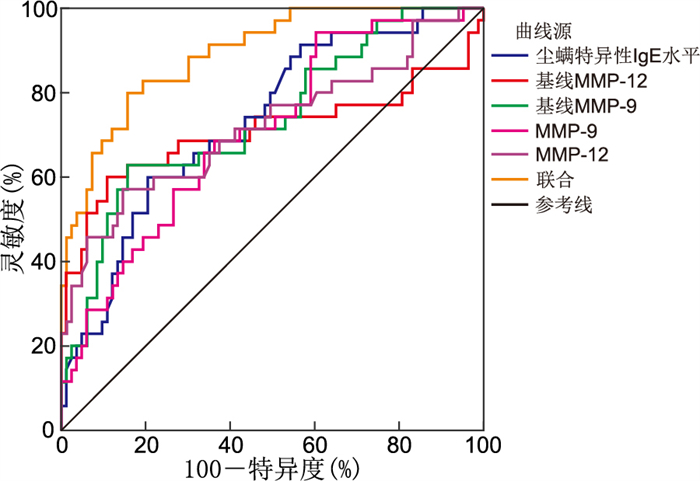
图 1 各指标预测AR患儿SCIT反应性的ROC曲线
Figure 1. ROC curves for each indicator predicting the SCIT reactivity in children with AR
表 1 有效组与无效组AR患儿临床资料比较
Table 1. Comparison of clinical characteristics between AR children in the effective group and the ineffective group
项目 有效组
(n=83)无效组
(n=35)统计量 P值 年龄(x±s,岁) 9.41±2.39 8.40±2.95 1.793a 0.079 性别[例(%)] 0.525b 0.469 男 39(46.99) 19(54.29) 女 44(53.01) 16(45.71) 疾病严重程度[例(%)] 0.136b 0.712 中 62(74.70) 25(71.43) 重 21(25.30) 10(28.57) 病程[M(P25, P75),年] 1.50(1.00, 2.50) 1.50(1.00, 3.00) 1.519c 0.134 同居室吸烟[例(%)] 15(18.07) 11(31.43) 2.556b 0.110 过敏原种类[例(%)] 4.255b 0.039 单一 57(68.67) 17(48.57) 多重 26(31.33) 18(51.43) 基线症状评分(x±s,分) 2.07±0.58 2.24±0.52 4.521a < 0.001 药物评分(x±s,分) 1.34±0.40 1.37±0.45 0.630a 0.531 CSMS评分(x±s,分) 3.41±0.47 3.51±0.49 2.692a 0.009 基线血清IgE水平(x±s,IU/mL) 139.00±34.35 142.50±32.44 0.526a 0.601 血清尘螨特异性IgE水平(x±s,IU/mL) 11.10±3.10 14.20±2.79 5.331a < 0.001 FEV1水平(x±s,%) 98.87±11.26 97.50±12.46 0.561a 0.577 EOS[M(P25, P75),×109/L] 0.30(0.15, 0.45) 0.27(0.13, 0.36) 1.782c 0.080 基线MMP-9(x±s,ng/mL) 156.60±25.64 172.46±26.95 2.962a 0.004 基线MMP-12(x±s,pg/mL) 1 213.55±203.22 1 367.11±411.54 2.102a 0.042 △MMP-9(x±s,ng/mL) 113.74±12.53 102.58±14.47 3.977a < 0.001 △MMP-12(x±s,pg/mL) 642.57±100.74 597.33±110.49 2.084a 0.041 注:a为t值,b为χ2值,c为U值。  下载: 导出CSV
表 2 变量赋值情况
Table 2. Variable assignment situation
变量 赋值方法 SCIT反应性 有效=0,无效=1 过敏原种类 单一=0,多重=1 基线症状评分 以实际值赋值 CSMS评分 以实际值赋值 血清尘螨特异性IgE水平 以实际值赋值 基线MMP-9 以实际值赋值 基线MMP-12 以实际值赋值 △MMP-9 以实际值赋值 △MMP-12 以实际值赋值
下载: 导出CSV
表 3 AR患儿SCIT反应性影响因素的logistic回归分析
Table 3. Logistic regression analysis of factors influencing SCIT reactivity in AR children
变量 B SE Wald χ2 P值 OR值 95% CI 过敏原种类 0.776 0.594 1.707 0.191 2.172 0.678~6.954 基线症状评分 0.735 0.570 1.667 0.197 2.086 0.693~6.373 CSMS评分 1.055 0.581 3.303 0.069 2.873 0.921~8.965 血清尘螨特异性IgE水平 0.300 0.115 6.780 0.009 1.349 1.077~1.691 基线MMP-9 0.036 0.013 7.499 0.006 1.036 1.010~1.063 基线MMP-12 0.029 0.011 6.398 0.011 1.029 1.006~1.052 △MMP-9 -0.070 0.024 8.703 0.003 0.932 0.890~0.977 △MMP-12 -0.073 0.036 4.196 0.041 0.929 0.867~0.997 常数 -7.338 4.652 2.489 0.115
下载: 导出CSV
表 4 各指标对MMP患儿预后不良的预测效能分析
Table 4. Predictive value of risk factors for poor prognosis in children with MMP
项目 阈值 SE AUC 95% CI 灵敏度
(%)特异度
(%)尤登
指数血清尘螨特异性IgE水平 13.35 IU/mL 0.050 0.733 0.644~0.810 60.00 79.52 0.395 基线MMP-9 165.23 ng/mL 0.052 0.738 0.649~0.814 62.86 84.34 0.472 基线MMP-12 1318.12 pg/mL 0.066 0.709 0.618~0.789 60.00 89.16 0.492 △MMP-9 107.58 ng/mL 0.052 0.706 0.615~0.787 94.29 39.76 0.340 △MMP-12 619.54 pg/mL 0.057 0.722 0.632~0.800 57.14 85.54 0.427 联合 0.34 0.031 0.891 0.821~0.941 80.00 84.34 0.643
下载: 导出CSV
-
[1] 中华耳鼻咽喉头颈外科杂志编辑委员会鼻科组, 中华医学会耳鼻咽喉头颈外科学分会鼻科学组、小儿学组. 儿童变应性鼻炎诊断和治疗指南(2022年, 修订版)[J]. 中华耳鼻咽喉头颈外科杂志, 2022, 57(4): 392-404.Subspecialty Group of Rhinology, Editorial Board of Chinese Journal of Otorhinolaryngology Head and Neck Surgery, Subspecialty Groups of Rhinology and Pediatrics, Society of Otorhinolaryngology Head and Neck Surgery, Chinese Medical Association. Guideline for diagnosis and treatment of pediatric allergic rhinitis (2022, revision)[J]. Chinese Journal of Otorhinolaryngology Head and Neck Surgery, 2022, 57(4): 392-404. [2] 中国医师协会变态反应医师分会, 中国医师协会儿科医师分会耳鼻咽喉专业委员会, 中国人体健康科技促进会儿童变态反应分会. 儿童过敏性鼻炎阶梯治疗中国专家共识[J]. 中华预防医学杂志, 2022, 56(9): 1182-1189.Allergy Branch of Chinese Medical Doctor Association Otolaryngology Group, Society of Pediatrics, Chinese Medical Doctor Association Child Allergy Professional Committee. Chinese expert consensus on stepwise treatment of pediatric allergic rhinitis[J]. Chinese Journal of Preventive Medicine, 2022, 56(9): 1182-1189. [3] ZHOU Y D, XU M, GONG W, et al. Circulating MMP-12 as potential biomarker in evaluating disease severity and efficacy of sublingual immunotherapy in allergic rhinitis[J]. Mediators Inflamm, 2022, 2022: 3378035. DOI: 10.1155/2022/3378035. [4] ZHU Y, ZHOU J, TANG R, et al. M2 macrophage-derived Apolipoprotein E promotes fibroblast MMPs expression via LRP1-ERK signaling in chronic rhinosinusitis with nasal polyps[J]. Mucosal Immunol, 2025, 18(5): 1171-1183. doi: 10.1016/j.mucimm.2025.07.004 [5] ZHANG Y Q, SHUI J, WANG L, et al. Serum proteomics identifies S100A11 and MMP9 as novel biomarkers for predicting the early efficacy of sublingual immunotherapy in allergic rhinitis[J]. Int Immunopharmacol, 2023, 124(Pt A): 110857. DOI: 10.1016/j.intimp.2023.110857. [6] 高永祥, 张晋昕. Logistic回归分析的样本量确定[J]. 循证医学, 2018, 18(2): 122-124.GAO Y X, ZHANG J X. Determination of Sample Size in Logistic Regression Analysis[J]. The Journal of Evidence-Based Medicine, 2018, 18(2): 122-124. [7] 中国过敏性鼻炎研究协作组. 过敏性鼻炎皮下免疫治疗的临床操作规范[J]. 中国耳鼻咽喉头颈外科, 2018, 25(1): 1-12.Chinese Collaborative Group for Allergic Rhinitis Research. Clinical operational standards for subcutaneous immunotherapy in allergic rhinitis[J]. Chinese Archives of Otolaryngology-Head and Neck Surgery, 2018, 25(1): 1-12. [8] CRETICOS P S, GUNAYDIN F E, NOLTE H, et al. Allergen immunotherapy: the evidence supporting the efficacy and safety of subcutaneous immunotherapy and sublingual forms of immunotherapy for allergic rhinitis/conjunctivitis and asthma[J]. J Allergy Clin Immunol Pract, 2024, 12(6): 1415-1427. doi: 10.1016/j.jaip.2024.04.034 [9] PARK M, KAPOOR S, YI J L, et al. Sublingual immunotherapy persistence and adherence in real-world settings: a systematic review[J]. Int Forum Allergy Rhinol, 2023, 13(5): 924-941. doi: 10.1002/alr.23086 [10] 尚虹, 邵磊, 胡崇伟. 过敏性鼻炎患儿变应原特异性免疫治疗前后炎症因子表达谱变化及其意义[J]. 中华全科医学, 2024, 22(9): 1555-1558. doi: 10.16766/j.cnki.issn.1674-4152.003681SHANG H, SHAO L, HU C W. Changes in inflammatory factors in children with allergic rhinitis before and after allergen-specific immunotherapy: expression spectrum and clinical significance[J]. Chinese Journal of General Practice, 2024, 22(9): 1555-1558. doi: 10.16766/j.cnki.issn.1674-4152.003681 [11] KELSO J M. Open-label study of the efficacy, safety, and durability of peanut sublingual immunotherapy in peanut-allergic children[J]. Pediatrics, 2024, 154(Suppl 4): S29. DOI: 10.1542/peds.2024-069114IK. [12] LI H B, CHEN S, CHENG L, et al. Chinese guideline on sublingual immunotherapy for allergic rhinitis and asthma[J]. J Thorac Dis, 2019, 11(12): 4936-4950. doi: 10.21037/jtd.2019.12.37 [13] PAN Y, ZHANG X X, GENG H T, et al. Increased nasal blimp1+treg cells after sublingual immunotherapy reflect the efficacy of treatment in allergic rhinitis[J]. Adv Ther, 2024, 41(4): 1698-1710. doi: 10.1007/s12325-024-02819-8 [14] PYLE C J, PATEL D F, PEIRó T, et al. Matrix Metalloproteinase-12 supports pulmonary B cell follicle formation and local antibody responses during asthma[J]. Am J Respir Crit Care Med, 2022, 206(11): 1424-1428. doi: 10.1164/rccm.202109-2082LE [15] RAVANETTI L, DEKKER T, GUO L H, et al. Efficacy of FP-025: a novel matrix metalloproteinase-12 (MMP-12) inhibitor in murine allergic asthma[J]. Allergy, 2023, 78(2): 559-562. doi: 10.1111/all.15513 [16] CHALISE U, BECIROVIC-AGIC M, KONFRST S R, et al. MMP-12 polarizes neutrophil signalome towards an apoptotic signature[J]. J Proteomics, 2022, 264: 104636. DOI: 10.1016/j.jprot.2022.104636. [17] SUN Y, TAM W K, ZHU M Y, et al. MMP12-dependent myofibroblast formation contributes to nucleus pulposus fibrosis[J]. JCI Insight, 2025, 10(7): e180809. DOI: 10.1172/jci.insight.180809. [18] CHIU K L, HE J L, CHEN G L, et al. Impacts of matrix metalloproteinase-9 promoter genotypes on asthma risk[J]. In Vivo, 2024, 38(5): 2144-2151. doi: 10.21873/invivo.13677 [19] MING H, HUANG Y M, MAO J J, et al. Changes and clinical significance of serum MMP-9, TIMP-1, COX-2, and immune levels in patients with asthma[J]. Allergol Immunopathol (Madr), 2023, 51(6): 83-88. doi: 10.15586/v51i6.924 [20] WANG N, SONG J, SUN S R, et al. Immune signatures predict response to house dust mite subcutaneous immunotherapy in patients with allergic rhinitis[J]. Allergy, 2024, 79(5): 1230-1241. doi: 10.1111/all.16068
 点击查看大图
计量
- 文章访问数: 11
- HTML全文浏览量: 5
- PDF下载量: 1
- 被引次数: 0
