



Potential profile analysis of parenting competence of parturients in obstetric wards and its relationship with anxiety and depression
-
摘要:
目的 探讨产科病房产妇育儿胜任感的潜在类别,分析不同类别与焦虑抑郁的关系,为早期识别育儿适应不良群体及开展针对性心理干预提供依据。 方法 选取2024年6月—2025年10月温州医科大学附属第二医院产科病房305例产妇为调查对象。采用中文版育儿胜任感量表(C-PSOC)、产后特有焦虑量表中文版(PSAS-CN)、中文版产后抑郁筛查量表(C-PDSS)评估产妇育儿胜任感、焦虑症状、抑郁症状。通过潜在剖面分析产科病房产妇育儿胜任感的潜在类别特征,采用多元线性回归分析产妇焦虑抑郁的影响因素。 结果 本研究共发放问卷305份,3份问卷缺失超过10%,4份问卷疑似逻辑错误,最终纳入研究的有效问卷298份,有效回收率为97.70%。298例产科病房产妇C-PSOC、PSAS-CN及C-PDSS评分分别为(77.94±8.14)分、(72.93±12.45)分、(57.30±11.08)分。本研究识别出3个潜在类别,分别为低效能组(73例,24.50%)、低满意度组(95例,31.88%)、高胜任感组(130例,43.62%)。初产妇、妊娠期合并症、有新生儿健康问题、配偶未参与照顾新生儿、育儿胜任感潜在类别为低效能组是产科病房产妇焦虑的影响因素,年龄≥35岁、家庭月收入<5 000元、配偶未参与照顾新生儿、育儿胜任感潜在类别为低满意度组是产科病房产妇抑郁的影响因素(P<0.05)。 结论 产科病房产妇育儿胜任感存在异质性,育儿胜任感类别与产妇焦虑抑郁密切相关。本研究结果有助于产科医护人员优化心理干预策略,以缓解产妇焦虑抑郁情绪。 Abstract:Objective To explore the potential categories of parenting sense of competence among puerperae in obstetrical wards, analyze the relationship between different categories and anxiety/depression, and provide evidence for early identification of groups with poor parenting adaptation as well as targeted psychological interventions. Methods The study selected 305 parturients from the obstetric ward of the Second Affiliated Hospital of Wenzhou Medical University between June 2024 and October 2025 as survey participants. The Chinese version of the parenting sense of competency scale (C-PSOC), the Chinese version of the postpartum specific anxiety scale (PSAS-CN), and the Chinese version of the postpartum depression screening scale (C-PDSS) were used to evaluate the parenting competency, anxiety symptoms, and depression symptoms of the parturients. The potential category characteristics of the parenting competence of parturients in the obstetric ward were analyzed through the potential profile. Multivariate linear regression analysis was used to identify the influencing factors of anxiety and depression in parturients. Results A total of 305 questionnaires were distributed, among which 3 had more than 10% missing data, and 4 were suspected of logical errors. Ultimately, 298 valid questionnaires were included in the analysis, yielding an effective response rate of 97.70%. The scores of C-PSOC, PSAS-CN, and C-PDSS of 298 parturients in the obstetric ward were (77.94±8.14) points, (72.93±12.45) points, and (57.30±11.08) points, respectively. This study identified three potential categories, which were respectively named the low-efficiency group (73 cases, 24.50%), the low-satisfaction group (95 cases, 31.88%), and the high-competence group (130 cases, 43.62%). Primiparas, comorbidities during pregnancy, having neonatal health problems, the spouse not participating in the care of the newborn, and the potential category of parenting competence being the low-efficiency group are the influencing factors of anxiety among parturients in the obstetric ward, and Age ≥35 years old, monthly family income < 5 000 yuan, spouse not involved in caring for newborns, and potential category of low satisfaction in parenting competence are the influencing factors of depression among parturients in the obstetric ward (P < 0.05). Conclusion There is heterogeneity in the parenting competence of parturients in the obstetric ward. The categories of parenting competence are closely related to the anxiety and depression of parturients, which is helpful for obstetric medical staff to optimize psychological intervention strategies to alleviate the anxiety and depression of parturients. -
Key words:
- Obstetric wards /
- Puerperae /
- Anxiety /
- Depression /
- Parenting competence /
- Potential profile analysis
-

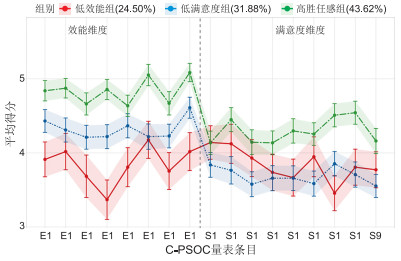
图 1 产科病房产妇育儿胜任感潜在类别的特征分布
注:E表示效能维度,S表示满意度维度。
Figure 1. Characteristic distribution of latent classes of parenting sense of competence among puerperae in obstetrical wards
表 1 产科病房产妇育儿胜任感潜在剖面分析模型拟合结果(n=298)
Table 1. Model fit indices for latent profile analysis of parenting sense of competence among puerperae in obstetrical wards (n=298)
模型 AIC BIC aBIC Entropy LMRT (P值) BLRT (P值) 类别概率(%) 1 7 326.582 7 400.238 7 375.412 100.00 2 6 792.126 6 932.108 6 810.007 0.934 <0.001 <0.001 54.35/45.65 3 6 312.054 6 532.158 6 400.258 0.970 0.016 <0.001 24.50/31.88/43.62 4 6 224.935 6 432.007 6 296.987 0.892 0.035 <0.001 25.07/30.01/10.23/34.69 5 6 016.324 6 130.004 6 099.236 0.903 0.276 <0.001 14.34/22.31/15.12/17.95/30.28  下载: 导出CSV
表 2 不同一般资料产妇PSAS-CN评分比较
Table 2. Comparison of PSAS-CN scores among puerperae with different general characteristics
项目 例数 PSAS-CN评分(x±s,分) 统计量 P值 年龄 1.603a 0.110 <35岁 218 72.24±11.98 ≥35岁 80 74.81±13.02 产妇类型 3.838a <0.001 初产妇 179 75.25±13.27 经产妇 119 69.44±12.05 家庭月收入 0.440b 0.644 <5 000元 59 73.15±12.06 5 000~10 000元 153 72.59±13.28 >10 000元 86 71.30±11.92 妊娠期合并症 4.334a <0.001 有 86 76.98±10.26 无 212 70.44±12.37 新生儿体重 1.241b 0.291 <2.5 kg 48 74.29±13.84 2.5~4.0 kg 225 72.25±12.76 >4.0 kg 25 69.29±13.05 新生儿健康问题 3.585a <0.001 有 62 78.03±12.06 无 236 71.59±12.72 配偶参与照顾新生儿 3.743a <0.001 是 203 70.96±13.72 否 95 77.14±12.29 育儿胜任感潜在类别 8.861b <0.001 低效能组 73 77.53±13.62 低满意度组 95 71.69±11.94 高胜任感组 130 69.88±12.37 注:a为t值,b为F值。
下载: 导出CSV
表 3 不同一般资料产妇C-PDSS评分比较
Table 3. Comparison of C-PDSS scores among puerperae with different general characteristics
项目 例数 C-PDSS评分(x±s,分) 统计量 P值 年龄 3.831a <0.001 <35岁 218 55.82±10.92 ≥35岁 80 61.33±11.23 产妇类型 0.841a 0.401 初产妇 179 56.87±10.64 经产妇 119 57.95±11.17 家庭月收入 6.388b 0.002 <5 000元 59 60.06±11.32 5 000~10 000元 153 58.12±10.57 >10 000元 86 53.95±11.18 妊娠期合并症 1.448a 0.149 有 86 58.83±12.41 无 212 56.68±11.28 新生儿体重 0.050b 0.952 <2.5 kg 48 56.89±10.26 2.5~4.0 kg 225 57.35±10.71 >4.0 kg 25 57.63±11.49 新生儿健康问题 1.061a 0.290 有 62 58.61±10.57 无 236 56.96±10.98 配偶参与照顾新生儿 5.291a <0.001 是 203 55.07±10.43 否 95 62.07±11.09 育儿胜任感潜在类别 14.759b <0.001 低效能组 73 55.82±11.72 低满意度组 95 62.39±12.03 高胜任感组 130 54.41±10.25 注:a为t值,b为F值。
下载: 导出CSV
表 4 自变量赋值情况
Table 4. The assignment situation of independent variables
自变量 赋值方法 年龄 <35岁=0,≥35岁=1 产妇类型 初产妇=0,经产妇=1 家庭月收入 <5 000元=0,5 000~10 000元=1,>10 000元=2 妊娠期合并症 无=0,有=1 新生儿健康问题 无=0,有=1 配偶参与照顾新生儿 无=0,有=1 育儿胜任感潜在类别 以“高胜任感组”为参照设置哑变量,高胜任感组=(0, 0),低效能组=(1, 0),低满意度组=(0, 1)
下载: 导出CSV
表 5 产科病房产妇焦虑影响因素的多元线性回归分析
Table 5. Multiple linear regression analysis of anxiety among puerperae in obstetrical wards
变量 β SE β′ t值 P值 产妇类型 -0.427 0.158 -0.416 -2.703 0.024 妊娠期合并症 0.436 0.165 0.422 2.642 0.025 新生儿健康问题 0.481 0.153 0.453 3.144 0.018 配偶参与照顾新生儿 -0.398 0.181 -0.380 -2.199 0.041 育儿胜任感潜在类别 低效能组 0.137 0.224 0.122 0.612 0.115 低满意度组 0.518 0.149 0.504 3.477 0.008 注:R2=0.459, 调整后R2=0.442, F=24.359, P<0.001。本表仅列出差异有统计学意义的变量。
下载: 导出CSV
表 6 产科病房产妇抑郁影响因素的多元线性回归分析
Table 6. Multiple linear regression analysis of depression among puerperae in obstetrical wards
变量 β SE β′ t值 P值 年龄 0.408 0.174 0.397 2.345 0.038 家庭月收入 -0.414 0.169 -0.402 -2.450 0.034 配偶参与照顾新生儿 -0.389 0.189 -0.375 -2.058 0.046 育儿胜任感潜在类别 低效能组 0.150 0.233 0.128 0.644 0.102 低满意度组 0.521 0.154 0.505 3.383 0.010 注:R2=0.438, 调整后R2=0.420, F=20.009, P<0.001。本表仅列出差异有统计学意义的变量。
下载: 导出CSV
-
[1] WANG Y C, GU J, ZHANG F, et al. The multiple mediation model of social support and postpartum anxiety symptomatology: the role of resilience, postpartum stress, and sleep problems[J]. BMC Psychiatry, 2024, 24(1): 630-646. doi: 10.1186/s12888-024-06087-2 [2] QIN Z, PAN Y Y, YANG H D, et al. Prevalence and risk factors of postpartum depression, anxiety, and comorbidity of both disorders: a cross-sectional study[J]. BMC Pregnancy Childbirth, 2025, 25(1): 1352. DOI: 10.1186/s12884-025-08512-0. [3] ZHU Y, ZHOU X, YIN X X, et al. Parenting sense of competence and its predictors among primiparous women: a longitudinal study in China[J]. BMC Pregnancy Childbirth, 2022, 22(1): 548. DOI: 10.1186/s12884-022-04881-y. [4] HUANG L, WANG X J, LIU G H, et al. Parenting sense of competence among Chinese parents of premature infants: a cross-sectional study[J]. BMC Pregnancy Childbirth, 2023, 23(1): 399. DOI: 10.1186/s12884-023-05703-5. [5] SHANG X C, LI L, NIU C M, et al. Relationship between social support and parenting sense of competence in puerperal women: multiple mediators of resilience and postpartum depression[J]. Front Psychiatry, 2022, 13(1): 986797. DOI: 10.3389/fpsyt.2022.986797. [6] 梁珊, 于腾飞, 刘文敬, 等. 父母产后抑郁与育儿胜任感: 有调节的中介效应[J]. 中国临床心理学杂志, 2021, 29(5): 1040-1044.LIANG S, YU T F, LIU W J, et al. Relationship between Postpartum Depression and Parenting Sense of Competence of Parents: A Moderated Mediating Effect[J]. Chinese Journal of Clinical Psychology, 2021, 29(5): 1040-1044. [7] 项旦丹, 曹雪宏, 余海英, 等. 早产儿母亲育儿支持现状及影响因素分析[J]. 中华全科医学, 2023, 21(8): 1347-1350. doi: 10.16766/j.cnki.issn.1674-4152.003120XIANG D D, CAO X H, YU H Y, et al. Analysis of status quo and influencing factors of parental support of premature mothers[J]. Chinese Journal of General Practice, 2023, 21(8): 1347-1350. doi: 10.16766/j.cnki.issn.1674-4152.003120 [8] 杨晓, 高玲玲, 张振香, 等. 中文版育儿胜任感量表在产妇中应用的信效度检验[J]. 中华护理杂志, 2014, 49(7): 881-885.YANG X, GAO L L, ZHANG Z X, et al. The reliability and validity of the Chinese version of Parenting Sense of Competence Scale[J]. Chinese Journal of Nursing, 2014, 49(7): 881-885. [9] 徐继红, 孙琛, 闫盼盼, 等. 产后特有焦虑量表的中文版修订及信效度检验[J]. 中国临床心理学杂志, 2021, 29(3): 554-558.XU J H, SUN C, YAN P P, et al. RRevision and Reliability and Validity Evaluation of the Chinese Version of the Postpartum Specific Anxiety Scale[J]. Chinese Journal of Clinical Psychology, 2021, 29(3): 554-558. [10] 李榕, 邵红, 朱启英. 产后抑郁筛查量表的研译及评价[J]. 中国妇幼保健, 2009, 24(5): 607-610.LI R, SHAO H, ZHU Q Y. Translation and assessment of postpartum depression screening scale[J]. Maternal and Child Health Care of China, 2009, 24(5): 607-610. [11] 李懿蔚, 王婷, 马一玮, 等. 上海市虹口区产褥期妇女育儿胜任感现状及影响因素分析[J]. 华南预防医学, 2021, 47(9): 1131-1134.LI Y W, WANG T, MA Y W, et al. Status and influencing factors of parenting sense of competence among puerperal women in Hongkou District, Shanghai[J]. South China Journal of Preventive Medicine, 2021, 47(9): 1131-1134. [12] 张叶. 产后特有焦虑的潜在类别分析及影响因素[D]. 济南: 山东大学, 2022.ZHANG Y. Latent class analysis and influencing factors of postpartum specific anxiety[D]. Jinan: Shandong University, 2022. [13] MENG W, SHALAYIDING S, WANG X, et al. Relationship between prenatal anxiety, depression, pregnancy stress and their social determinants[J]. BMC Psychol, 2025, 13(1): 905. doi: 10.1186/s40359-025-03237-3 [14] 刘文娟, 李静静, 金杏. 高龄初产妇产后抑郁与育儿胜任感的相关性研究[J]. 中国医药导报, 2024, 21(9): 112-115.LIU W J, LI J J, JIN X. Study on the correlation between postpartum depression and parenting sense of competence in elderly primipara[J]. China Medical Herald, 2024, 21(9): 112-115. [15] SU X J, ZHANG Y Z, CHEN M D, et al. Influencing factors and risk prediction modeling of maternal postpartum depression: a cross-sectional study in Chinese puerperal women of sitting the month[J]. Front Psychiatry, 2023, 14(1): 1252789. DOI: 10.3389/fpsyt.2023.1252789. [16] WU D D, JIANG L, ZHAO G L. Additional evidence on prevalence and predictors of postpartum depression in China: a study of 300 000 puerperal women covered by a community-based routine screening programme[J]. J Affect Disord, 2022, 307: 264-270. doi: 10.1016/j.jad.2022.04.011 [17] ALSHIKH AHMAD H, ALKHATIB A, LUO J Y. Prevalence and risk factors of postpartum depression in the Middle East: a systematic review and meta-analysis[J]. BMC Pregnancy Childbirth, 2021, 21(1): 542. DOI: 10.1186/s12884-021-04016-9. [18] 毕云天, 马运荣, 李红. 初产妇产后抑郁的产前影响因素分析[J]. 国际精神病学杂志, 2025, 52(5): 1522-1524, 1532.BI Y T, MA Y R, LI H. Analysis of Prenatal Influencing Factors of Postpartum Depression in Primiparous Women[J]. Journal of International Psychiatry, 2025, 52(5): 1522-1524, 1532. [19] QI W J, ZHAO F Q, LIU Y T, et al. Psychosocial risk factors for postpartum depression in Chinese women: a meta-analysis[J]. BMC Pregnancy Childbirth, 2021, 21(1): 174. DOI: 10.1186/s12884-021-03657-0. [20] 吴怡, 张梦婷. 高龄孕产妇血清ApoB IL-18表达与产后抑郁相关性分析[J]. 河北医学, 2020, 26(12): 1952-1956.WU Y, ZHANG M T. The Correlations Between the Expressions of ApoB IL-18 and Postpartum Depression in Elderly Pregnant Women[J]. Hebei Medicine, 2020, 26(12): 1952-1956.
 点击查看大图
计量
- 文章访问数: 12
- HTML全文浏览量: 7
- PDF下载量: 3
- 被引次数: 0
