



Study on the trajectory and influencing factors of fatigue in maintenance hemodialysis patients
-
摘要:
目的 探讨维持性血液透析(MHD)患者疲乏发展轨迹的潜在类别,并分析其影响因素。 方法 选取2024年2月—2025年1月于浙江大学医学院附属邵逸夫医院行维持性血液透析的171例患者,收集患者的一般资料、实验室指标、透析间期体重增加(IDWG)、疲乏程度评分、社会支持评分及共病指数。采用潜在类别增长混合模型(GMM)拟合MHD患者14天疲乏轨迹的潜在类别,采用logistic回归分析研究疲乏轨迹的影响因素。 结果 出现疲乏患者116例(67.84%),疲乏程度有4个轨迹:无疲乏组55例(32.16%)、疲乏持续组62例(36.26%)、疲乏缓解组39例(22.81%)和疲乏升高组15例(8.77%)。Logistic回归分析显示,性别为女性、年龄≥60岁、透析龄≥ 60个月、IDWG、共病指数增大是维持性血液透析患者疲乏的危险因素,社会支持(高评分)则可能是维持性血液透析患者疲乏的保护因素。 结论 维持性血液透析患者存在4种疲乏变化轨迹,且有群体异质性;性别为女性、年龄≥60岁、透析龄≥ 60个月、IDWG、共病指数增大是维持性血液透析患者疲乏的危险因素,社会支持(高评分)则可能是维持性血液透析患者疲乏的保护因素。 Abstract:Objective To study the trajectory of fatigue changes and its influencing factors in maintenance hemodialysis (MHD) patients. Methods A total of 171 patients undergoing maintenance hemodialysis at Sir Run Run Shaw Hospital, Zhejiang University School of Medicine from February 2024 to January 2025 were selected. Their general information, laboratory indicators, interdialysis weight gain (IDWG), fatigue score, social support score and comorbidity index were collected. Latent class growth mixture modeling (GMM) was used to fit the latent class of fatigue trajectory of MHD patients for 14 days, and logistic analysis was used to analyze the influencing factors of fatigue trajectory. Results There were 116 cases (67.84%) with fatigue patients, and the degree of fatigue had four trajectories: 55 cases (32.16%) in the "no fatigue group", 62 cases (36.26%) in the "persistent fatigue group", 39 cases (22.81%) in the "fatigue relief group", and 15 cases (8.77%) in the "elevated fatigue group". Logistic regression analysis showed that: female, age ≥60 years, dialysis age ≥60 months, IDWG, an increase in comorbidity index were risk factors for fatigue in maintenance hemodialysis patients, while social support (high score) was a protective factor for fatigue in maintenance hemodialysis patients. Conclusion There are four fatigue trajectories in maintenance hemodialysis patients, and there is population heterogeneity. female, age ≥60 years, dialysis age ≥60 months, IDWG, an increase in comorbidity index are risk factors for fatigue in maintenance hemodialysis patients, while social support (high score) is a protective factor for fatigue in maintenance hemodialysis patients. -
Key words:
- Hemodialysis /
- Fatigue /
- Change trajectory /
- Influence factors
-

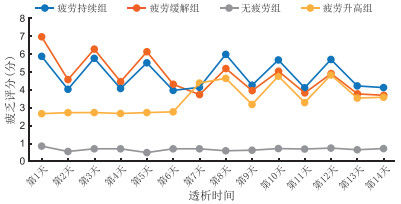
图 1 MHD患者疲乏变化轨迹
注:第1、3、5、8、10、12天为透析日。
Figure 1. The fatigue change trajectory of MHD patients
表 1 MHD患者疲乏轨迹潜在类别模型的拟合情况
Table 1. The fitting situation of the latent class model for the fatigue trajectory of MHD patients
模型 AIC BIC aBIC Entropy LMR BLRT 类别概率 1 7 582.664 7 594.712 7 588.251 1.000 2 7 562.893 7 556.438 7 547.366 0.893 <0.001 <0.001 0.639/0.361 3 7 558.375 7 548.752 7 536.974 0.846 0.021 <0.001 0.260/0.314/0.426 4 7 541.867 7 526.944 7 528.058 0.882 0.007 <0.001 0.172/0.097/0.433/0.298 5 7 549.169 7 536.278 7 540.749 0.875 0.152 0.089 0.095/0.267/0.138/0.379/0.121  下载: 导出CSV
表 2 MHD患者的一般资料及疲乏轨迹潜在类别的单因素分析
Table 2. Univariate analysis of general data and potential categories of fatigue trajectories in MHD patients
项目 例数 无疲乏组(n=55) 疲乏持续组(n=62) 疲乏缓解组(n=39) 疲乏升高组(n=15) 统计量 P值 性别(例) 18.133a <0.001 男性 91 37 27 25 2 女性 80 18 35 14 13 年龄(例) 13.618a 0.034 <45岁 53 33 14 15 10 45~<60岁 83 16 31 18 7 ≥60岁 35 6 17 6 6 透析龄(例) 28.240a <0. 001 < 36个月 84 35 25 23 1 36~ < 60个月 57 17 23 11 6 ≥60个月 30 3 14 5 8 教育程度(例) 54.118a <0.001 初中及以下 60 9 33 6 12 高中及中专 59 20 24 13 2 大专及以上 52 26 5 20 1 工作情况(例) 2.319a 0. 509 在职 67 22 28 12 5 不在职 104 33 34 27 10 婚姻状况(例) 5.307a 0. 505 未婚 13 5 3 3 2 已婚 141 48 35 32 26 离异或丧偶 17 2 5 4 6 居住情况(例) 2.247a 0.523 独居 36 8 15 9 4 与他人居住 135 47 47 30 11 医疗费支付方式(例) 2.279a 0. 892 职工医保 116 38 40 26 12 新农合 8 2 3 2 1 居民医保 47 15 19 11 2 实验室指标(x±s) PAB(mg/dL) 29.08±2.75 32.88±3.12 27.73±2.64 31.91±3.06 23.76±2.38 67.752b <0.001 Hb(g/L) 114.73±9.68 128.33±10.56 101.24±7.15 109.64±8.42 94.07±6.91 62.971b <0.001 CRP(mg/L) 13.94±2.38 8.07±1.82 14.63±2.86 13.03±2.11 16.67±3.94 68.457b <0.001 IDWG(x±s,kg) 2.85±0.74 2.52±0.35 2.96±0.79 2.68±0.52 3.27±0.86 8.193b <0.001 社会支持(x±s,分) 29.63±5.44 41.03±6.58 25.49±4.85 33.28±5.94 20.76±3.99 96.273b <0.001 共病指数(x±s,分) 3.54±0.82 2.27±0.43 3.94±0.88 2.99±0.74 5.32±1.08 86.736b <0.001 注:a为χ2值,b为F值。
下载: 导出CSV
表 3 自变量赋值情况
Table 3. The assignment situation of independent variables
自变量 赋值方法 性别 男性=0,女性=1 年龄 <45岁=0,45~<60岁=1,≥60岁=2 透析龄 < 36个月=0, 36~ < 60个月=1, ≥60个月=2 教育程度 大专及以上=0,高中及中专=1,初中及以下=2 PAB 以实际值赋值 Hb 以实际值赋值 CRP 以实际值赋值 IDWG 以实际值赋值 社会支持 以实际值赋值 共病指数 以实际值赋值
下载: 导出CSV
表 4 MHD患者疲乏轨迹潜在类别的多分类logistic回归分析
Table 4. Multiclass logistic regression analysis of potential categories of fatigue trajectories in MHD patients
变量 B SE Waldχ2 P值 OR值 95% CI 疲乏持续组 女性 1.528 0.601 9.643 0.002 4.609 1.735~7.556 年龄≥60岁 1.907 0.732 13.088 <0.001 6.733 1.945~12.286 透析龄≥60个月 1.326 0.481 6.347 0.014 3.766 1.896~5.685 IDWG 1.166 0.943 17.256 <0.001 3.209 1.408~4.972 共病指数(增大) 0.794 0.262 5.913 0.012 2.212 1.502~2.987 社会支持(高评分) 0.647 0.382 4.385 0.031 1.910 1.399~2.524 疲乏缓解组 女性 0.903 0.476 7.241 0.028 2.407 1.454~3.306 年龄≥60岁 1.349 0.315 5.237 0.032 3.854 2.769~4.868 透析龄≥60个月 1.244 0.832 10.275 0.013 3.469 1.982~5.085 IDWG 0.947 0.325 6.009 0.018 2.578 1.462~3.637 共病指数(增大) 1.028 0.542 13.210 <0.001 2.795 1.642~3.808 社会支持(高评分) 1.154 0.772 5.093 0.041 2.869 1.825~3.706 疲乏升高组 女性 1.351 0.923 17.264 <0.001 3.861 2.147~6.294 年龄≥60岁 1.284 0.808 9.325 0.009 3.611 1.976~5.803 透析龄≥60个月 0.735 0.341 5.048 0.012 2.085 1.370~2.586 IDWG 1.562 0.814 7.559 0.007 4.768 2.742~5.507 共病指数(增大) 0.909 0.653 6.407 0.009 2.482 1.523~3.564 社会支持(高评分) 1.068 0.373 5.044 0.025 2.909 1.727~4.142
下载: 导出CSV
-
[1] 郝艳华, 姜亚芳. 维持性血液透析患者症状经历的调查研究[J]. 中华护理杂志, 2016, 51(3): 299-303.HAO Y H, JIANG Y H. Symptom experiences among maintenance hemodialysis patients: a cross-sectional study[J]. Chinese Journal of Nursing, 2016, 51(3): 299-303. [2] 张颖, 刘雪琴, 刘晓辉, 等. 维持性血液透析患者疲乏发生率及影响因素的系统评价[J]. 中华护理教育, 2023, 20(11): 1391-1397.ZHANG Y, LIU X Q, LIU X H, et al. Systematic review of fatigue prevalence and its influencing factors in patients with maintenance hemodialysis[J]. Chinese Journal of Nursing Education, 2023, 20(11): 1391-1397. [3] 武佼佼, 郝艳华, 田青, 等. 血液透析患者疲乏的影响因素与干预措施研究进展[J]. 中国护理管理, 2016, 16(12): 1717-1720.WU J J, HAO Y H, TIAN Q, et al. Research progress of fatigue in hemodialysis patients[J]. Chinese Nursing Management, 2016, 16(12): 1717-1720. [4] 卢亚慈, 温福星, 林秋菊, 等. 探讨血液透析病人疲惫的变化型态及其预测因素[J]. 护理杂志, 2023, 70(2): 56-66.LU Y C, WEN F X, LIN Q J, et al. Exploring the changing patterns of fatigue in hemodialysis patients and their predictive factors[J]. Nursing Journal, 2023, 70(2): 56-66. [5] 肖水源. 《社会支持评定量表》的理论基础与研究应用[J]. 临床精神医学杂志, 1994(2): 98-100.XIAO S Y. Theoretical Foundation and Research Application of the "Social Support Rating Scale"[J]. Journal of Clinical Psychiatry, 1994(2): 98-100. [6] CHARLSON M, SZATROWSKI T P, PETERSON J, et al. Validation of a combined comorbidity index[J]. J Clin Epidemiol, 1994, 47(11): 1245-1251. doi: 10.1016/0895-4356(94)90129-5 [7] ZYGA S, ALIKARI V, SACHLAS A, et al. Assessment of fatigue in end stage renal disease patients undergoing hemodialysis: prevalence and associated factors[J]. Med Arch, 2015, 69(6): 376-380. doi: 10.5455/medarh.2015.69.376-380 [8] 王维平, 姜璐, 张强, 等. 心肺运动试验指导下运动康复对血液透析患者免疫功能及疲劳程度的影响[J]. 现代中西医结合杂志, 2022, 31(10): 1337-1341, 1427.WANG W P, JIANG L, ZHANG Q, et al. Effects of exercise rehabilitation under the guidance of cardiopulmonary exercise test on immune function and fatigue in hemodialysis patients[J]. Modern Journal of Integrated Traditional Chinese and Western Medicine, 2022, 31(10): 1337-1341, 1427. [9] 李露, 王丽梅, 齐佳红, 等. 透析中关节活动度运动对维持性血液透析患者疲乏症状和运动能力的影响研究[J]. 中国血液净化, 2024, 23(7): 552-556.LI L, WANG L M, QI J H, et al. The effect of joint mobility exercises in dialysis on fatigue symptoms and exercise capacity in mainte-nance hemodialysis patients究[J]. Chinese Journal of Blood Purification, 2024, 23(7): 552-556. [10] 刘冰燕, 王莉, 张莉, 等. 基于MDT模式的5E康复方案在老年维持性血液透析患者中的干预效果[J]. 中华全科医学, 2024, 22(8): 1359-1363. doi: 10.16766/j.cnki.issn.1674-4152.003636LIU B Y, WANG L, ZHANG L, et al. 5E rehabilitation program based on MDT model effect of intervention on elderly maintenance hemodialysis patients[J]. Chinese Journal of General Practice, 2024, 22(8): 1359-1363. doi: 10.16766/j.cnki.issn.1674-4152.003636 [11] 陈凌云, 倪松, 施凌云, 等. 尿毒症患者维持性血液透析疲乏与衰弱发生率及其影响因素研究[J]. 中国中西医结合肾病杂志, 2021, 22(2): 116-120.CHEN L Y, NI S, SHI L Y, et al. Study on the Incidence and Influencing Factors of Fatigue and Weakness of Maintenance Hemodialysis in Patients with Uremia[J]. Chinese Journal of Integrated Traditional and Western Nephrology, 2021, 22(2): 116-120. [12] FAIOLI A, BERGESIO G, SAMà C, et al. Predictors of fatigue among patients on hemodialysis: an observational study[J]. Cureus, 2024, 16(8): e65953. DOI: 10.7759/cureus.65953. [13] 殷贵兰, 傅荣, 叶然. 维持性血液透析病人疲乏状况及其影响因素探讨[J]. 实用老年医学, 2018, 32(10): 919-922.YIN G L, FU R, YE R. Status and influencing factors of fatigue in the patients with maintenance hemodialysis[J]. Practical Geriatrics, 2018, 32(10): 919-922. [14] 侯瑞, 宋明芬, 亢俊俊, 等. 维持性血液透析患者疲乏影响因素及其与心理弹性、希望之间的相关性分析[J]. 中华全科医学, 2021, 19(2): 266-269. doi: 10.16766/j.cnki.issn.1674-4152.001784HOU R, SONG M F, KANG J J, et al. Influencing factors of fatigue in in maintenance hemodialysis patients and their correlation with psychological resilience and hope[J]. Chinese Journal of General Practice, 2021, 19(2): 266-269. doi: 10.16766/j.cnki.issn.1674-4152.001784 [15] TSIRIGOTIS S, POLIKANDRIOTI M, ALIKARI V, et al. Factors associated with fatigue in patients undergoing hemodiaiysis[J]. Cureus, 2022, 14(3): e22994. DOI: 10.7759/cureus.22994. [16] 吴瑕, 郭璇, 翟独秀. 老年维持性血液透析患者的疲乏及其相关因素研究[J]. 老年医学与保健, 2024, 30(5): 1429-1433.WU X, GUO X, ZHAI D X. A study of fatigue and its related factors in elderly patients undergoing maintenance hemodialysis[J]. Geriatrics & Health Care, 2024, 30(5): 1429-1433. [17] 王娟, 朱元, 王薪. 维持性血液透析患者透析后疲乏的相关因素分析及护理措施[J]. 医疗装备, 2024, 37(15): 131-133.WANG J, ZHU Y, WANG X. Analysis of related factors and nursing measures for post dialysis fatigue in maintenance hemodialysis patients[J]. Chinese Journal of Medical Device, 2024, 37(15): 131-133. [18] 凌雪霞, 陈若如, 林婵婵, 等. 围绝经期维持性血液透析患者疲乏状况及影响因素分析[J]. 中国妇幼保健, 2024, 39(18): 3642-3645.LING X X, CHEN R R, LIN C C, et al. Analysis of Fatigue Status and Influencing Factors in Perimenopausal Maintenance Hemodialysis Patients[J]. Maternal & Child Health Care of China, 2024, 39(18): 3642-3645. [19] 程帮兰, 沈倪晶, 姚鹏云. 老年肾衰竭血液透析患者生活质量与心理弹性、社会支持、自我感受负担的相关性[J]. 老年医学与保健, 2024, 30(1): 185-189.CHENG B L, SHEN N J, YAO P Y. Correlation between quality of life and psychological resilience, social support and self-perceived burden in elderly patients un-dergoing hemodialysis for renal failure[J]. Geriatrics & Health Care, 2024, 30(1): 185-189. [20] 洛桑扎西, 李婷. 维持性血液透析患者健康素养、社会支持及自我管理现状的调查分析[J]. 延边大学医学学报, 2024, 47(4): 447-450.Luosangzhaxi, LI T. Investigation and analysis of health literacy, social support, and self-management status of maintenance hemodialysis patients[J]. Journal of Medical Science Yanbian University, 2024, 47(4): 447-450.
 点击查看大图
计量
- 文章访问数: 9
- HTML全文浏览量: 5
- PDF下载量: 2
- 被引次数: 0
