



Construction and validation of a predictive model for reduced bone mass in adolescent idiopathic scoliosis
-
摘要:
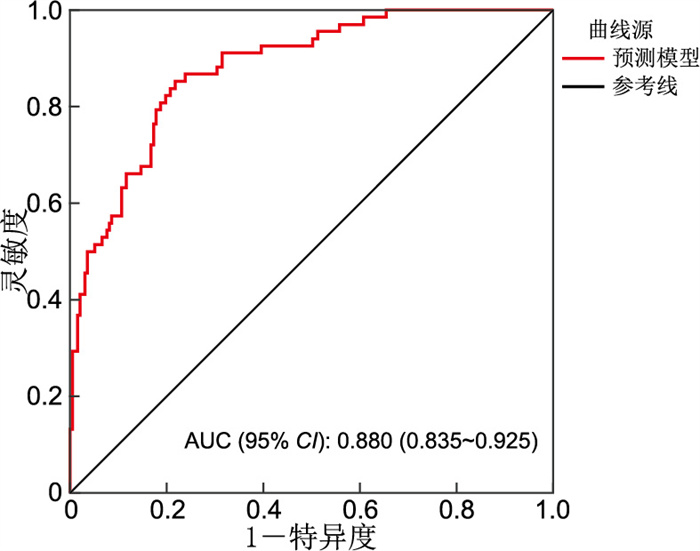
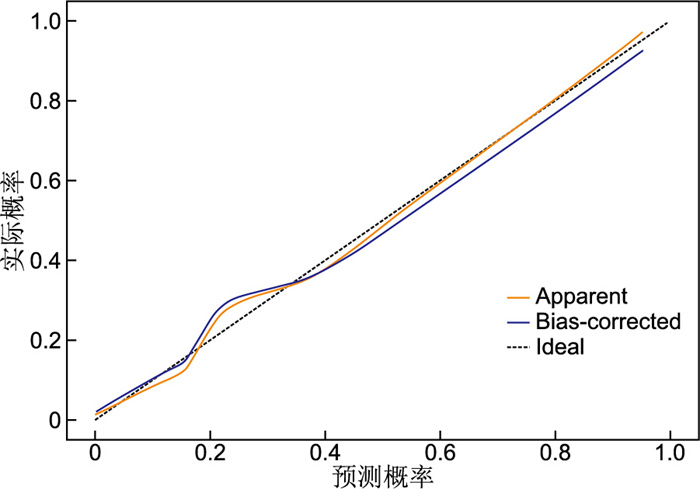
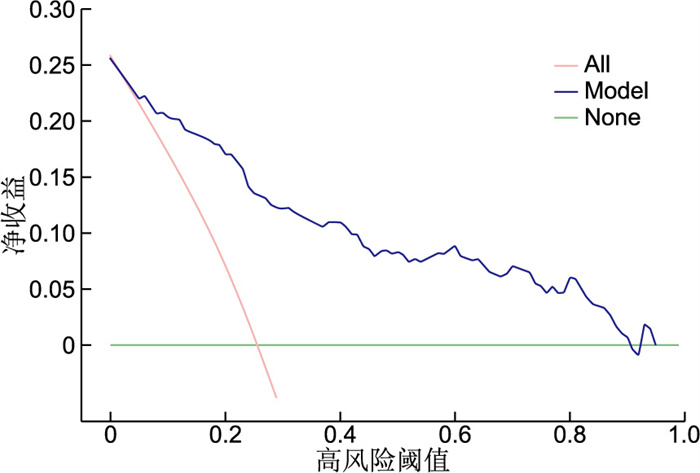
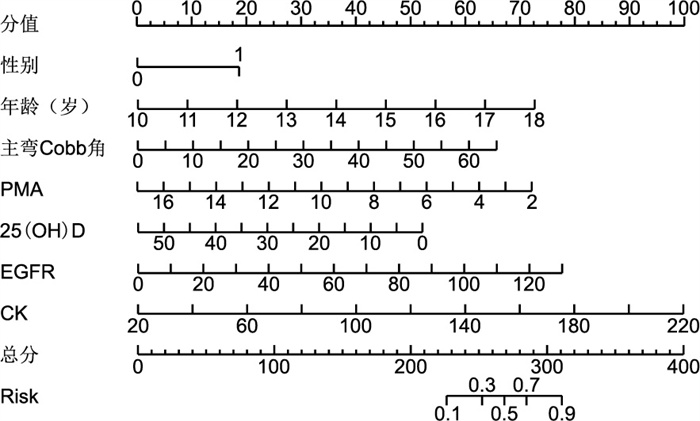
目的 探讨青少年特发性脊柱侧凸(AIS)患者骨量减少影响因素,构建并验证列线图预测模型。 方法 选取2022年2月—2025年10月滁州市第一人民医院收治的265例AIS患者,依据腰椎骨密度分为骨量正常组(197例)和骨量减少组(68例)。采用logistic回归筛选独立预测因子并构建列线图,通过ROC曲线、校准曲线及决策曲线分析(DCA)评估模型性能。 结果 女性(OR=2.663,P=0.019)、年龄增长(OR=1.613,P < 0.001)、主弯Cobb角增大(OR=1.049,P=0.019)、表皮生长因子受体(EGFR)水平升高(OR=1.026,P=0.027)、肌酸激酶(CK)水平升高(OR=1.026,P < 0.001)是骨量减少的危险因素,椎旁肌横截面积(PMA)增大(OR=0.797,P=0.007)、25-羟维生素D[(25(OH)D]水平升高(OR=0.949,P=0.038)是保护因素。模型ROC曲线下面积(AUC)为0.880(95% CI:0.835~0.925);校准良好,Hosmer-Lemeshow检验χ2=8.510,P=0.385;DCA显示在0.1~0.6阈值范围具有临床净获益。 结论 基于性别、年龄、主弯Cobb角、PMA、25(OH)D、EGFR及CK构建的列线图模型具有良好的区分度、校准度与临床实用性,可为AIS患者骨量减少的早期风险量化评估与干预提供可视化工具。 -
关键词:
- 青少年特发性脊柱侧凸 /
- 骨量减少 /
- 影响因素 /
- 预测模型 /
- 列线图
Abstract:Objective To explore the influencing factors of reduced bone mass reduction in adolescents with idiopathic spinal curvature (AIS) and to develop and validate a nomogram prediction model. Methods A total of 265 patients with AIS treated at the First People's Hospital of Chuzhou from February 2022 to October 2025 were selected. They were divided into the normal bone mass group (197 cases) and the reduced bone mass group (68 cases) based on lumbar bone density. Multivariate logistic regression analysis was used to identify independent predictors and construct a nomogram. The performance of the model was evaluated through ROC curve, calibration curve and decision curve analysis (DCA). Results Multivariate analysis showed that female (OR=2.663, P=0.019), increasing age (OR=1.613, P < 0.001), increase in the Cobb angle of the main curve (OR=1.049, P=0.019), elevated epidermal growth factor receptor (EGFR) level (OR=1.026, P=0.027), and elevated creatine kinase (CK) level (OR=1.026, P < 0.001) are risk factors for bone loss. An increase in the cross-sectional area of paravertebral muscles (PMA, OR=0.797, P=0.007) and elevated 25-hydroxyvitamin D [(25(OH)D] level (OR=0.949, P=0.038) are protective factors. The model demonstrated good discrimination, with an area under the ROC curve (AUC) of 0.880 (95% CI: 0.835-0.925). Calibration was satisfactory, as indicated by the Hosmer-Lemeshow test (χ2=8.510, P=0.385). DCA showed a favorable net clinical benefit across threshold probabilities of 0.1-0.6. Conclusion The nomogram incorporating gender, age, main curvature Cobb angle, PMA, 25(OH)D, EGFR, and CK demonstrates good discrimination, calibration, and clinical practicability. It may serve as a visual tool for early risk assessment and intervention for reduced bone mass in AIS patients. -
Key words:
- Adolescent idiopathic scoliosis /
- Reduced bone mass /
- Influencing factors /
- Predictive model /
- Nomogram
-

图 1 AIS患者骨量减少的列线图预测模型
Figure 1. The nomogram prediction model for bone loss in AIS patients

图 2 模型预测AIS患者骨量减少的ROC曲线
Figure 2. The ROC curve for predicting bone loss in AIS patients by the model
表 1 AIS患者骨量减少的单因素分析
Table 1. Univariate analysis of bone density reduction in AIS patients
项目 骨量正常组(n=197) 骨量减少组(n=68) 统计量 P值 性别[例(%)] 6.895a 0.009 男性 100(50.76) 22(32.35) 女性 97(49.24) 46(67.65) 年龄(x±s,岁) 13.58±2.23 15.82±2.16 7.199b <0.001 女性月经初潮年龄(x±s,岁) 12.35±1.21 12.67±1.34 1.427b 0.156 BMI(x±s) 19.48±2.67 18.52±2.43 2.614b 0.010 病程(x±s,月) 17.65±4.36 18.93±5.14 1.991b 0.048 运动习惯[例(%)] 2.455a 0.117 规律运动 82(41.62) 21(30.88) 不规律运动 115(58.38) 47(69.12) 饮食习惯[例(%)] 2.148a 0.143 均衡 151(76.65) 46(67.65) 不均衡 46(23.35) 22(32.35) 主弯Cobb角(x±s,°) 27.83±9.76 32.02±11.85 2.883b 0.004 顶椎位置[例(%)] 0.451a 0.798 胸段 115(58.38) 39(57.35) 胸腰段 59(29.95) 19(27.94) 腰段 23(11.68) 10(14.71) Risser征[例(%)] 4.664a 0.031 0~2级 86(43.65) 40(58.82) 3~5级 111(56.35) 28(41.18) PMA(x±s,cm2) 9.28±2.45 8.46±2.38 2.397b 0.017 椎旁肌肌力分级[例(%)] 5.032a 0.025 0~2级 50(25.38) 27(39.71) 3~5级 147(74.62) 41(60.29) Ca(x±s,mmol/L) 2.39±0.14 2.37±0.16 0.978b 0.329 P(x±s,mmol/L) 1.53±0.26 1.51±0.29 0.531b 0.596 ALP(x±s,U/L) 179.45±68.32 191.28±75.44 1.198b 0.232 PTH(x±s,pg/mL) 36.89±14.52 40.75±17.83 1.779b 0.077 25(OH)D(x±s,ng/mL) 25.34±7.89 22.93±6.75 2.250b 0.025 OCN(x±s,ng/mL) 43.87±15.64 49.02±19.05 2.209b 0.028 P1NP(x±s,ng/mL) 446.85±97.62 469.73±104.35 1.637b 0.103 β-CTX(x±s,ng/mL) 0.53±0.19 0.60±0.25 2.405b 0.017 EGFR(x±s,ng/mL) 62.25±19.75 71.83±23.48 3.280b 0.001 Mb(x±s,ng/mL) 42.35±18.52 45.78±20.05 1.289b 0.199 CK(x±s,U/L) 114.65±32.48 145.32±36.75 6.486b <0.001 注:a为χ2值,b为t值。  下载: 导出CSV
表 2 AIS患者骨量减少的多因素logistic回归分析
Table 2. Multivariate logistic regression analysis of bone density reduction in AIS patients
变量 B SE Waldχ2 P值 OR值 95%CI 性别 0.980 0.419 5.478 0.019 2.663 1.173~6.049 年龄 0.478 0.093 24.345 <0.001 1.613 1.334~1.951 主弯Cobb角 0.048 0.020 5.495 0.019 1.049 1.008~1.092 PMA -0.227 0.084 7.265 0.007 0.797 0.675~0.940 25(OH)D -0.052 0.025 4.286 0.038 0.949 0.903~0.997 EGFR 0.025 0.011 4.861 0.027 1.026 1.003~1.049 CK 0.026 0.006 16.537 <0.001 1.026 1.014~1.039 常量 -12.159 2.736 19.747 <0.001 <0.001 注:骨量正常=0,骨量减少=1;男=0,女=1;年龄、主弯Cobb角、PMA、25(OH)D、EGFR、CK为连续变量。本表仅列出差异有统计学意义的变量。
下载: 导出CSV
-
[1] 冷寒, 温剑涛, 何勇, 等. 青少年特发性脊柱侧凸患者中椎间盘性状改变的研究进展[J]. 实用骨科杂志, 2025, 31(3): 231-234.LENG H, WEN J T, HE Y, et al. Research progress on intervertebral disc changes in adolescent idiopathic scoliosis patients[J]. Journal of Practical Orthopaedics, 2025, 31(3): 231-234. [2] 王培鑫, 赵军, 徐世红, 等. 青少年特发性脊柱侧凸与骨量减少的相关性研究进展[J]. 中华骨质疏松和骨矿盐疾病杂志, 2025, 18(1): 112-119.WANG P X, ZHAO J, XU S H, et al. Advance in correlation between adolescent idiopathic scoliosis and low bone mass[J]. Chinese Journal of Osteoporosis And Bone Mineral Research, 2025, 18(1): 112-119. [3] TAN J, NG C, HART N H, et al. Reduced peak bone mass in young adults with low motor competence[J]. J Bone Miner Res, 2023, 38(5): 665-677. [4] CHEN L, WU X Y, JIN Q, et al. The correlation between osteoporotic vertebrae fracture risk and bone mineral density measured by quantitative computed tomography and dual energy X-ray absorptiometry: a systematic review and meta-analysis[J]. Eur Spine J, 2023, 32(11): 3875-3884. doi: 10.1007/s00586-023-07917-9 [5] 丁家秀, 董龙家, 刘淘真, 等. 高龄老年患者代谢综合征及其组分与骨质疏松症的关系及其诊疗分析[J]. 贵州医科大学学报, 2022, 47(8): 926-930.DING J X, DONG L J, LIU T Z, et al. Analysis of the relationship between metabolic syndrome, its components and osteoporosis in elderly patients and its diagnosis and treatment[J]. Journal of Guizhou Medical University, 2022, 47(8): 926-930. [6] HILKENS L, VAN SCHIJNDEL N, WEIJER V, et al. Low bone mineral density and associated risk factors in elite cyclists at different stages of a professional cycling career[J]. Med Sci Sports Exerc, 2023, 55(5): 957-965. doi: 10.1249/MSS.0000000000003113 [7] 中华医学会物理医学与康复学分会. 青少年特发性脊柱侧凸康复诊疗指南(2024版)[J]. 中华医学杂志, 2024, 104(39): 3647-3660.Chinese Society of Physical Medicine and Rehabilitation. Guideline for rehabilitation assessment and treatment of adolescent idiopathic scoliosis (2024 edition)[J]. National Medical Journal of China, 2024, 104(39): 3647-3660. [8] 张海洪, 丛亚丽. 世界医学会《赫尔辛基宣言》2024版修订述评[J]. 医学与哲学, 2024, 45(21): 18-23.ZHANG H H, CONG Y L. A Review of the 2024 Revision of the World Medical Association Declaration of Helsinki[J]. Medicine and Philosophy, 2024, 45(21): 18-23. [9] 胡志俊, 闵文, 赵长伟. 中西医结合治疗骨量减少专家共识[J]. 中国中医骨伤科杂志, 2023, 31(2): 78-83.HU Z J, MIN W, ZHAO C W. Expert consensus on the combined treatment of osteopenia with traditional chinese and western medicine[J]. Chinese Journal of Traditional Medical Traumatology & Orthopedics, 2023, 31(2): 78-83. [10] JULIáN C, RICARDO D N, RODRIGO R, et al. Adolescent idiopathic scoliosis: is there a relationship between Risser staging and the proximal humerus ossification system?[J]. Spine Deform, 2024, 12(3): 629-633. doi: 10.1007/s43390-023-00812-9 [11] YANG X, ZHANG B L, LIU Y, et al. Automatic quantitative assessment of muscle strength based on deep learning and ultrasound[J]. Ultrason Imaging, 2024, 46(4/5): 211-219. [12] 梁海波, 金海明, 王向阳. 青少年特发性脊柱侧凸和骨密度的相关性研究进展[J]. 脊柱外科杂志, 2025, 23(2): 130-135.LIANG H B, JIN H M, WANG X Y. Research progress on correlation between adolescent idiopathic scoliosis and bone mineral density[J]. Journal of Spinal Surgery, 2025, 23(2): 130-135. [13] JI C, MA J, SUN L J, et al. Prediction model for low bone mass mineral density in type 2 diabetes: an observational cross-sectional study[J]. Endocrine, 2024, 86(1): 369-379. doi: 10.1007/s12020-023-03500-w [14] 张蕊馨, 谢晖, 蔡维维, 等. 社区老年人骨量减少患病率及影响因素分析[J]. 中国医药导报, 2022, 19(6): 52-55, 84.ZHANG R X, XIE H, CAI W W, et al. Analysis of the prevalence and influencing factors of osteopenia among the elderly in the community[J]. China Medical Herald, 2022, 19(6): 52-55, 84. [15] 王爱, 周冰倩, 于健, 等. 儿童青少年骨健康的评估及其影响因素[J]. 中国儿童保健杂志, 2024, 32(9): 980-983, 988.WANG A, ZHOU B Q, YU J, et al. Assessment and influencing factors of bone health in children and adolescents[J]. Chinese Journal of Child Health Care, 2024, 32(9): 980-983, 988. [16] NISHIDA M, YAGI M, SUZUKI S, et al. Persistent low bone mineral density in adolescent idiopathic scoliosis: a longitudinal study[J]. J Orthop Sci, 2023, 28(5): 1099-1104. doi: 10.1016/j.jos.2022.07.005 [17] 朱洲均, 张佳惠, 高健, 等. 表皮生长因子受体对小鼠关节软骨表层细胞增殖、分化、凋亡的影响[J]. 中国组织工程研究, 2023, 27(11): 1728-1732.ZHU Z J, ZHANG J H, GAO J, et al. Effects of epidermal growth factor receptor on proliferation, differentiation and apoptosis of mouse articular cartilage surface cells[J]. Chinese Journal of Tissue Engineering Research, 2023, 27(11): 1728-1732. [18] TADA M, OKANO T, MAMAOTO K, et al. Comparison of creatine kinase elevation caused by Janus kinase inhibitors and interleukin-6 inhibitors in patients with rheumatoid arthritis: a propensity score-matched study[J]. Arch Rheumatol, 2024, 39(3): 350-357. doi: 10.46497/ArchRheumatol.2024.10645 [19] CHIAPPARELLI E, OKANO I, ADL AMINI D, et al. The association between lumbar paraspinal muscle functional cross-sectional area on MRI and regional volumetric bone mineral density measured by quantitative computed tomography[J]. Osteoporos Int, 2022, 33(12): 2537-2545. doi: 10.1007/s00198-022-06430-x [20] ROCKWELL M S, KOSTELNIK S B, MCMILLAN R P, et al. An association between bioavailable 25-hydroxyvitamin D and bone mineral density in a diverse cohort of collegiate athletes[J]. Med Sci Sports Exerc, 2022, 54(3): 371-376. doi: 10.1249/MSS.0000000000002807 [21] CHEN F P, LIN Y C, LIN Y J, et al. Relationship between serum 25-hydroxyvitamin D and bone mineral density, fracture risk, and bone metabolism in adults with osteoporosis/fractures[J]. Endocr Pract, 2024, 30(7): 616-623. doi: 10.1016/j.eprac.2024.04.013 [22] 侯新华, 高英, 马依拉·买买提. 2型糖尿病患者血清25-羟维生素D水平对发生骨质疏松的风险预测模型构建[J]. 重庆医学, 2025, 54(2): 324-328, 334.HOU X H, GAO Y, Mayila·maimaiti. Serum 25-hydroxyvitamin D level in patients with type 2 diabetes mellitus and construction of risk prediction model for osteoporosis occurrence[J]. Chongqing Medicine, 2025, 54(2): 324-328, 334. [23] DAVIS C, LIE H M M E, VASANWALA R F, et al. Prevalence and risk factors associated with low bone mineral density in Asian adolescents with anorexia nervosa and atypical anorexia nervosa[J]. Int J Eat Disord, 2024, 57(4): 819-826. doi: 10.1002/eat.24076 [24] LI L W, CHENG S S, XU G Q. Application of neural network and nomogram for the prediction of risk factors for bone mineral density abnormalities: a cross-sectional NHANES-based survey[J]. Heliyon, 2023, 9(10): e20677. DOI: 10.1016/j.heliyon.2023.e20677. [25] WU G J, LEI C, GONG X B. Development and validation of a nomogram model for individualizing the risk of osteopenia in abdominal obesity[J]. J Clin Densitom, 2024, 27(2): 101469. DOI: 10.1016/j.jocd.2024.101469.
 点击查看大图
计量
- 文章访问数: 12
- HTML全文浏览量: 3
- PDF下载量: 2
- 被引次数: 0
