



Development and validation of a coagulation factor-based risk prediction model for hypertensive disorders of pregnancy
-
摘要:
目的 为提升妊娠期高血压疾病(HDP)的早期识别能力,本研究聚焦于凝血功能这一潜在预测维度,旨在系统评估凝血功能指标对HDP的预测价值,并以此为基础构建一个可用于临床风险评估的预测模型。 方法 回顾性纳入2020年1月—2023年12月东莞市厚街医院收治的533名孕妇(HDP组426例,非HDP组107例),采集孕妇凝血功能、肾功能、BMI、年龄等指标。通过单因素和多因素logistic回归筛选预测因子并构建列线图模型;采用受试者工作特征曲线(ROC)、校准曲线、决策曲线分析(DCA)及精确率-召回率曲线(PR)进行模型评估。 结果 多因素分析显示,高龄(≥35岁)、BMI≥25、尿蛋白阳性为HDP的独立危险因素,活化部分凝血活酶时间(APTT)和肌酐水平升高为保护因素。模型ROC曲线下面积为0.847(95% CI:0.810~0.884),校准曲线接近理想对角线,DCA显示在阈值概率0.25~0.75范围内具有显著临床净获益。 结论 基于APTT、高龄、BMI、尿蛋白和肌酐构建的列线图模型对HDP具有良好的预测效能,可为临床早期识别高危人群提供便捷、经济的量化工具。 Abstract:Objective To improve the early identification of hypertensive disorders of pregnancy (HDP), this study focused on coagulation function as a potential predictive dimension. We aimed to systematically evaluate the predictive value of coagulation indicators for HDP and to develop a clinically applicable risk assessment model based on these findings. Methods A retrospective study included 533 pregnant women admitted to Houjie Hospital, Dongguan from January 2020 to December 2023 (426 in the HDP group and 107 in the non-HDP group). Indicators including coagulation function, renal function, BMI, and age were collected. Predictive factors were screened through univariate and multivariate logistic regression to develop a nomogram model. Model performance was evaluated using receiver operating characteristic (ROC) curves, calibration curves, decision curve analysis (DCA), and precision-recall curves (PR). Results Multivariate analysis identified advanced maternal age (≥35 years), BMI ≥25, and proteinuria as independent risk factors for HDP, while elevated activated partial thromboplastin time (APTT) and creatinine were protective factors. The model achieved an area under the ROC curve (AUC) of 0.847 (95% CI: 0.810-0.884), with calibration curves close to the ideal diagonal and DCA demonstrating significant clinical net benefit within the threshold probability range of 0.25-0.75. Conclusion The nomogram model incorporating APTT, advanced maternal age, BMI, proteinuria, and creatinine demonstrated good predictive performance for HDP, providing a convenient and economical quantitative tool for early identification of high-risk populations in clinical practice. -

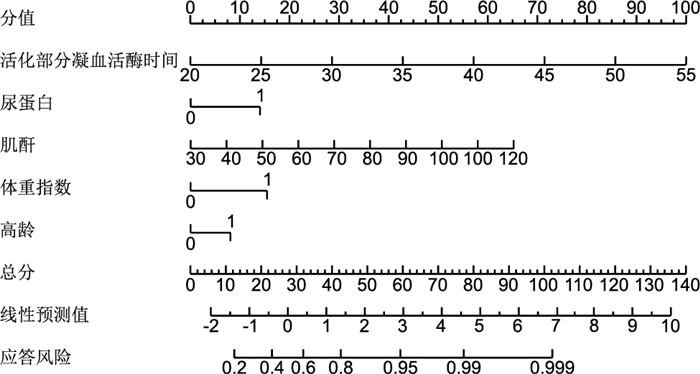
图 1 HDP风险预测列线图
注:列线图变量包括活化部分凝血活酶时间(连续性变量,以实际值赋值)、高龄(<35岁=0;≥35岁=1)、BMI(<25=0;≥25=1)、尿蛋白(阴性=0;阳性=1)、肌酐(连续性变量,以实际值赋值)。
Figure 1. Nomogram for predicting HDP risk

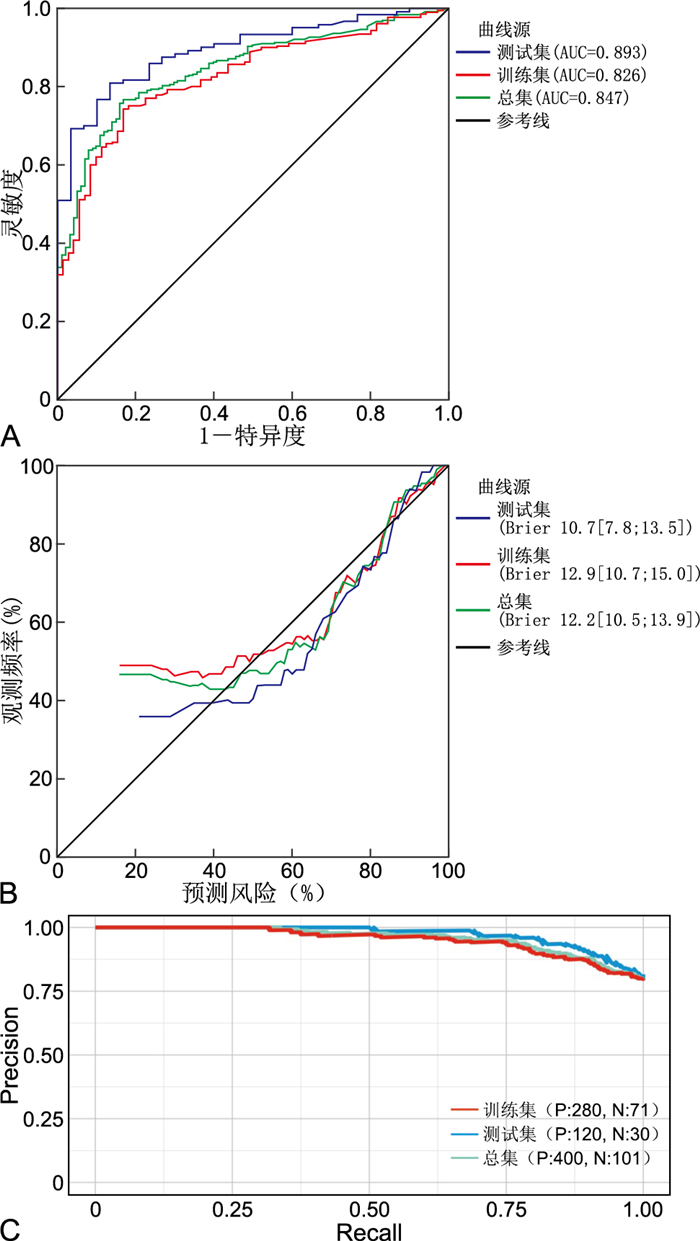
图 2 HDP预测模型的ROC曲线、校准曲线及PR曲线
注:图B的Brier评分×100表示。
Figure 2. ROC, calibration, and PR curves of the HDP prediction model
表 1 2组孕妇临床资料比较
Table 1. Comparison of clinical data between the two groups of pregnant women
项目 HDP组
(n=426)非HDP组
(n=107)统计量 P值 年龄(<35岁/≥35岁,例) 302/124 87/20 4.706a 0.030 凝血功能[例(%)] 423(80.0) 106(20.0) 0.999d PT[M(P25, P75),s] 10.5(10.0, 10.9) 10.6(10.3, 10.9) -2.274b 0.023 APTT(x±s,s) 27.0±2.6 25.6±2.0 5.936c <0.001 TT[M(P25, P75),s] 16.5(15.8, 17.1) 16.8(16.4, 17.1) -3.025b 0.002 Fib[M(P25, P75),g/L] 4.2(3.7, 4.8) 4.2(3.8, 4.6) 0.218b 0.640 D-二聚体[M(P25, P75),mg/L] 2.2(1.3, 3.2) 4.1(2.1, 5.6) -2.473b 0.013 R[M(P25, P75),分] 3.1(2.5, 3.8) 3.8(2.9, 4.3) -2.158b 0.031 K[M(P25, P75),分] 1.4(1.2, 1.8) 1.4(1.2, 1.7) -0.322b 0.748 α角[M(P25, P75),°] 73.0(68.1, 75.1) 72.5(69.7, 74.5) 0.382b 0.703 MA[M(P25, P75),ms] 68.3(64.3, 71.6) 67.3(62.5, 71.3) 0.544b 0.587 CI[M(P25, P75)] 3.3(2.3, 4.3) 2.8(1.9, 3.9) 1.366b 0.172 BMI(<25/≥25,例) 284/142 97/10 24.139a <0.001 尿蛋白(阴性/阳性,例) 259/150 94/12 25.098a <0.001 肌酐[M(P25, P75),μmol/L] 57.0(50.0, 65.0) 47.0(44.0, 53.0) 7.923b <0.001 尿酸[M(P25, P75),μmol/L] 400.5(333.1, 471.8) 347.7(296.5, 411.9) 4.721b <0.001 尿素氮[M(P25, P75),mmol/L] 3.5(2.8, 4.4) 3.0(2.5, 3.6) 4.353b <0.001 注:由于部分数据缺失,部分变量的有效样本量不同(凝血功能、D-二聚体、血栓弹力图、尿蛋白、肾功能);a为χ2值,b为Z值,c为t值, d为采用Fisher精确检验。  下载: 导出CSV
表 2 HDP影响因素的logistic回归分析
Table 2. Logistic regression results of the HDP prediction model
变量 B SE Waldχ2 P值 OR(95% CI) APTT -0.255 0.067 14.414 <0.001 0.775(0.679~0.884) BMI 1.625 0.376 18.716 <0.001 5.077(2.432~10.599) 尿蛋白 1.383 0.357 14.995 <0.001 3.986(1.980~8.025) 肌酐 -0.085 0.015 32.497 <0.001 0.919(0.893~0.946) 高龄 0.775 0.319 5.917 0.015 2.170(1.162~4.051) 注:二元多因素logistic回归中Hosmer-Lemeshow P=0.16,其中是HDP赋值为1,非HDP赋值为0。BMI<25赋值0,≥25赋值1;尿蛋白阴性赋值0,阳性赋值1;年龄<35岁赋值0,≥35岁赋值1,并定义为高龄;其余连续性变量以实际值赋值;本表仅列出差异有统计学意义的变量。
下载: 导出CSV
-
[1] 中华医学会心血管病学分会, 中华心血管病杂志编辑委员会. 妊娠期高血压疾病心血管风险综合管理专家共识[J]. 中华心血管病杂志, 2025, 53(3): 235-246.Chinese Society of Cardiology, Chinese Medical Association; Editorial Board of Chinese Journal of Cardiology. Expert consensus on the comprehensive cardiovascular risk management of hypertensive disorders in pregnancy[J]. Chinese Journal of Cardiology, 2025, 53(3): 235-246. [2] REALE S C, CAMANN W R. Preeclampsia[J]. N Engl J Med, 2022, 387(3): 286-287. doi: 10.1056/NEJMc2207559 [3] PENG X, CHINWE OLUCHI-AMAKA I, KWAK-KIM J, et al. A comprehensive review of the roles of T-cell immunity in preeclampsia[J]. Front Immunol, 2025, 16: 1476123. DOI: 10.3389/fimmu.2025.1476123. [4] MUSLIHA M, ANSARIADI, AMINUDDIN S, et al. Preeclampsia: etiology, pathophysiology, risk factors, impact and prevention: a narrative review[J]. Iran J Public Health, 2024, 53(11): 2392-2403. [5] 余忆, 王诚洁, 顾蔚蓉. 子痫前期危险因素在不同亚型中的特点[J]. 复旦学报(医学版), 2021, 48(1): 116-122.YU Y, WANG C J, GU W R. The characteristics of risk factors for pre-eclampsia in different sub-types[J]. Fudan University Journal of Medical Sciences, 2021, 48(1): 116-122. [6] ZENG L, LIAO C F. Multivariate logistic regression analysis of preeclampsia in patients with pregnancy induced hypertension and the risk predictive value of monitoring platelet, coagulation function and thyroid hormone in pregnant women[J]. Am J Transl Res, 2022, 14(9): 6805-6813. [7] CHEN Y Y, MA J T. The construction and validation of a prediction model of hypertensive disease in pregnancy[J]. Sci Rep, 2025, 15: 13406. DOI: 10.1038/s41598-025-98416-y. [8] 储华, 陆艳, 刘明松. 孕早期子宫动脉超声参数预测模型对子痫前期风险的预测价值[J]. 中华全科医学, 2023, 21(9): 1563-1565. doi: 10.16766/j.cnki.issn.1674-4152.003171CHU H, LU Y, LIU M S. Predictive value of uterine artery ultrasound parameter prediction model for preeclampsia risk in early pregnancy[J]. Chinese Journal of General Practice, 2023, 21(9): 1563-1565. doi: 10.16766/j.cnki.issn.1674-4152.003171 [9] 孔北华, 马丁, 段涛. 妇产科学[M]. 10版. 北京: 人民卫生出版社, 2024: 87-96.KONG B H, MA D, DUAN T. Obstetrics and Gynecology[M]. 10th ed. Beijing: People's Medical Publishing House, 2024: 87-96. [10] ULLMANN T, STEVENS N, HEUS P, et al. Evaluating variable selection methods for multivariable regression models: a simulation study protocol[J]. PLoS One, 2024, 19(9): e0309523. DOI: 10.1371/journal.pone.0309523. [11] COLLINS G S, DHIMAN P, MA J, et al. Evaluation of clinical prediction models (part 1): from development to external validation[J]. BMJ, 2024, 384: e074819. DOI: 10.1136/bmj-2023-074819. [12] COMMO F, LIQUET G, LAENEN B, et al. Internal validation strategy for high dimensional prognosis model: a simulation study and application to transcriptomic in head and neck tumors[J]. Brief Bioinform, 2024, 25(3): bbae178. DOI: 10.1093/bib/bbae178. [13] 朱映璇, 李杨, 吴疏桐, 等. ROC曲线和PR曲线在临床诊断试验评估中的应用[J]. 中华预防医学杂志, 2022, 56(9): 1341-1347.ZHU Y X, LI Y, WU S T, et al. Application of ROC and PR curves in the evaluation of clinical diagnostic testing[J]. Chinese Journal of Preventive Medicine, 2022, 56(9): 1341-1347. [14] RILEY R D, ARCHER L, SNELL K I E, et al. Evaluation of clinical prediction models (part 2): How to undertake an external validation study[J]. BMJ, 2024, 384: e074820. DOI: 10.1136/bmj-2023-074820. [15] DJULBEGOVIC B, HOZO I. Using decision curve analysis to evaluate testing and/or predictive modeling[M]//PETERSON H. Cancer Treatment and Research. Cham: Springer, 2023: 77-84. [16] 邓文静, 樊娜, 张娜, 等. 女性特发性肺间质纤维化并发肺气肿的危险因素分析及相关预测模型构建[J]. 西部医学, 2023, 35(11): 1615-1619, 1624.DENG W J, FAN N, ZHANG N, et al. Analysis of risk factors for emphysema in female patients with idiopathic pulmonary interstitial fibrosis and construction of related prediction models[J]. Medical Journal of West China, 2023, 35(11): 1615-1619, 1624. [17] HOOGLAND J, VAN DER LAAN M J, DEBRAY T P A, et al. Evaluating individualized treatment effect predictions: a model-based perspective on discrimination and calibration assessment[J]. Stat Med, 2024, 43(23): 4481-4498. doi: 10.1002/sim.10186 [18] HOZO I, GUYATT G, DJULBEGOVIC B. Decision curve analysis based on summary data[J]. J Eval Clin Pract, 2023, 30: 281-289. [19] PENG J, ZHAO Q X, PANG W, et al. Changes of coagulation function and platelet parameters in preeclampsia and their correlation with pregnancy outcomes[J]. J Clin Hypertens (Greenwich), 2024, 26(10): 1181-1187. doi: 10.1111/jch.14893 [20] HARTMANN J, HERMELIN D, LEVY J H. Viscoelastic testing: an illustrated review of technology and clinical applications[J]. Res Pract Thromb Haemost, 2023, 7(1): 100031. DOI: 10.1016/j.rpth.2022.100031.
 点击查看大图
计量
- 文章访问数: 18
- HTML全文浏览量: 12
- PDF下载量: 1
- 被引次数: 0
