



Construction and validation of a predictive model for the efficacy of neoadjuvant chemotherapy in patients with non-small cell lung cancer based on serum PI3K, AKT, and mTOR levels
-
摘要:
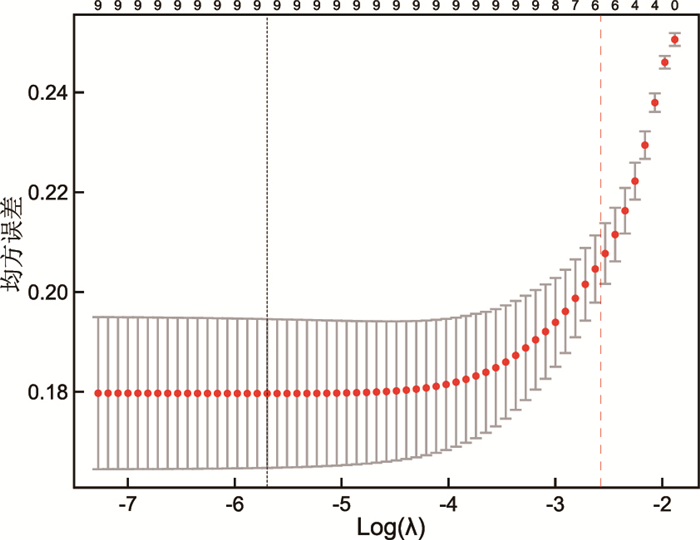
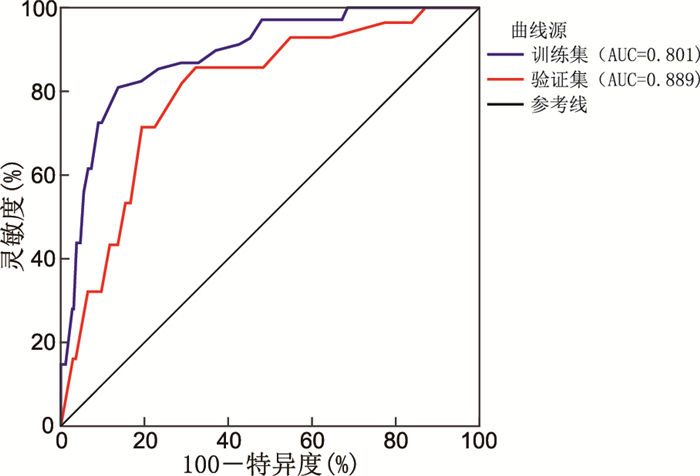
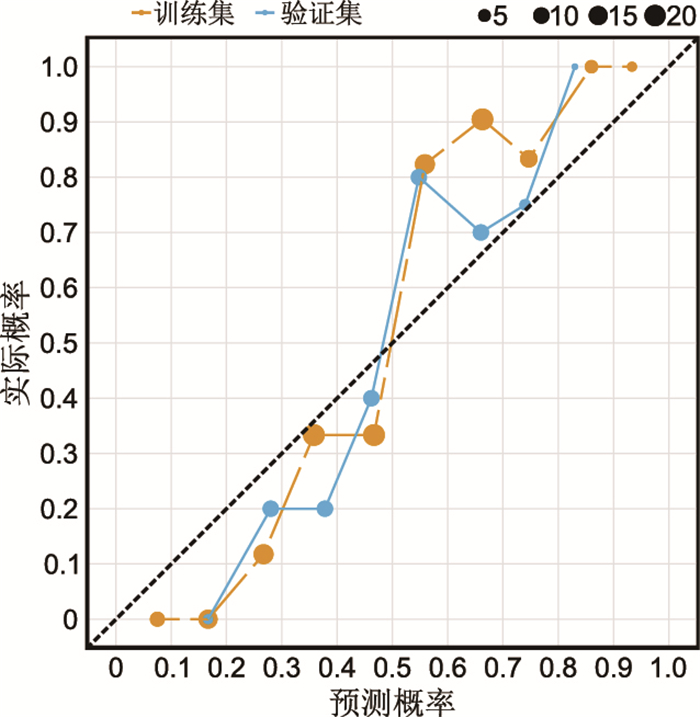
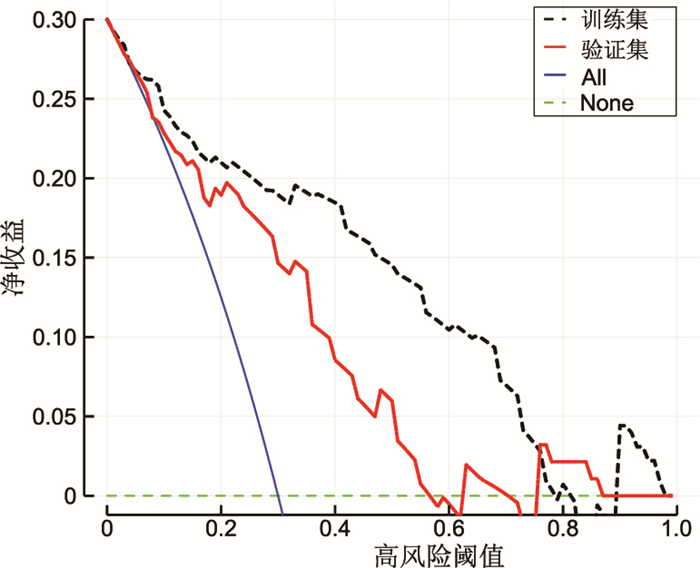
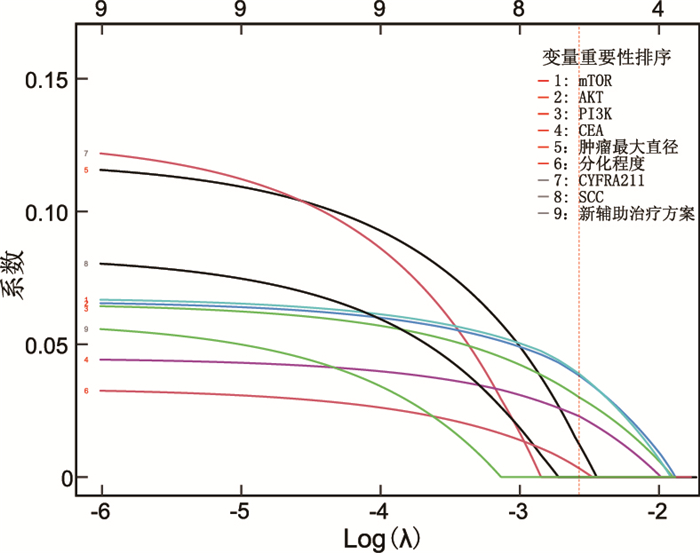
目的 非小细胞肺癌(NSCLC)新辅助治疗的疗效存在个体差异。磷脂酰肌醇-3-激酶(PI3K)/丝氨酸-苏氨酸激酶(Akt)/哺乳动物雷帕霉素靶蛋白(mTOR)通路是NSCLC发生发展的关键调节通路。本研究旨在探讨基于上述血清指标建立的预测模型效能,以指导临床治疗决策。 方法 选取2024年1月—2025年4月浙江中医药大学附属温州市中医院收治的200例NSCLC患者,以7∶3比例随机分为训练集(141例)、验证集(59例),化疗前行生化检查。采用LASSO回归筛选NSCLC患者新辅助治疗疗效相关特征变量,基于随机森林算法构建预测模型;通过ROC曲线下面积(AUC)、校准曲线及决策曲线(DCA)评估模型预测效能,并用验证集验证其稳定性。 结果 NSCLC患者新辅助治疗疗效相关变量包括肿瘤最大直径、分化程度、PI3K mRNA、AKT mRNA、mTOR mRNA、癌胚抗原(CEA)。训练集、验证集中随机森林模型的AUC分别为0.889、0.801。训练集、验证集随机森林模型的Brier得分分别为0.091、0.110。DCA曲线显示,训练集在0.10~0.76范围内高于None线,验证集在0.10~0.58范围内高于None线,训练集性能>验证集性能,符合模型验证的黄金法则。 结论 基于血清PI3K、AKT、mTOR水平建立的随机森林模型对NSCLC患者新辅助治疗疗效具有较高的预测效能,有助于辅助临床决策。 -
关键词:
- 非小细胞肺癌 /
- 磷脂酰肌醇-3-激酶 /
- 丝氨酸-苏氨酸激酶 /
- 哺乳动物雷帕霉素靶蛋白 /
- 新辅助治疗 /
- 疗效 /
- 预测模型
Abstract:Objective There are individual differences in the efficacy of neoadjuvant therapy for non-small cell lung cancer (NSCLC). Phosphatidylinositol-3-kinase (PI3K)/serine-threonine kinase (Akt)/mammalian target of rapamycin (mTOR) pathway is a key regulatory pathway for the occurrence and development of NSCLC. The aim of this study is to explore the efficacy of the prediction model based on the above serum indicators to guide clinical treatment decisions. Methods A total of 200 patients with NSCLC were selected from those admitted to Wenzhou Hospital of Traditional Chinese Medicine Affiliated to Zhejiang Chinese Medical University from January 2024 to April 2025. They were randomly divided into a training set (n=141) and a validation set (n= 59) in a 7∶3 ratio. Biochemical tests were conducted before chemotherapy. LASSO regression was employed to screen for characteristic variables associated with the efficacy of neoadjuvant therapy in NSCLC patients. A predictive model was then constructed based on the random forest algorithm. The predictive performance of the model was evaluated using the area under the receiver operating characteristic curve (AUC), calibration plots, and decision curve analysis (DCA), and was externally validated on the independent validation set. Results The variables related to the efficacy of neoadjuvant chemotherapy in NSCLC patients included the maximum diameter of the tumor, degree of differentiation, PI3K mRNA, AKT mRNA, mTOR mRNA, and carcinoembryonic antigen(CEA). A random forest model was constructed based on the variables related to the non-response of neoadjuvant chemotherapy in NSCLC patients screened out by LASSO regression, and the AUC values in the training set and the validation set were 0.889 and 0.801, respectively. The Brier scores in the training set and validation set random forest models were 0.091 and 0.110 respectively. The DCA curve revealed that, in the training set, the curve was above the "None" line within the threshold probability range of 0.10 to 0.76, while in the validation set, it remained above the "None" line from 0.10 to 0.58. The performance of the training set was superior to that of the validation set, adhering to the golden rule of model validation. Conclusion The random forest model established based on serum levels of PI3K, AKT, and mTOR demonstrates high predictive efficacy for the response to neoadjuvant chemotherapy in patients with NSCLC, thereby facilitating clinical decision-making. -

图 3 随机森林模型预测NSCLC患者新辅助治疗疗效的ROC曲线
Figure 3. ROC curve for predicting the efficacy of neoadjuvant therapy in NSCLC patients using the random forest model

图 4 随机森林模型评估NSCLC患者新辅助治疗疗效的校准曲线
Figure 4. Calibration curve of the random forest model for evaluating the efficacy of neoadjuvant therapy in NSCLC patients

图 5 随机森林模型评估NSCLC患者新辅助治疗疗效的DCA曲线
Figure 5. DCA curve of the random forest model for evaluating the efficacy of neoadjuvant therapy in NSCLC patients
表 1 2组NSCLC患者一般资料比较
Table 1. Comparison of baseline characteristics between two groups of NSCLC patients
组别 例数 性别(例) 年龄
(x±s, 岁)吸烟
(例)组织学分型(例) 肿瘤最大直径(例) 分化程度(例) ECOG-PS评分(例) 合并基础疾病(例) 新辅助治疗方案(例) 男性 女性 鳞癌 腺癌 ≤3 cm >3 cm 低分化 中高分化 0~1分 2分 高血压 糖尿病 高脂血症 免疫+化疗 单纯化疗 靶向治疗 未缓解组 96 66 30 60.09±5.83 62 76 20 21 75 56 40 43 53 28 9 17 60 18 18 缓解组 104 70 34 59.21±5.29 65 78 26 39 65 43 61 59 45 36 12 15 79 7 18 统计量 0.048a 1.119b 0.094a 0.489a 5.804a 5.763a 2.847a 0.681a 0.248a 0.401a 7.129a P值 0.827 0.264 0.760 0.484 0.016 0.016 0.092 0.409 0.618 0.527 0.028 注:a为χ2值,b为t值。  下载: 导出CSV
表 2 2组NSCLC患者血清PI3K、AKT、mTOR mRNA及肿瘤标志物水平比较(x±s)
Table 2. Comparison of serum PI3K, AKT, mTOR mRNA levels and tumor marker levels between two groups of NSCLC patients (x±s)
组别 例数 PI3K AKT mTOR CEA(μg/L) SCC(μg/L) CYFRA21-1(μg/L) 未缓解组 96 5.62±1.76 5.31±1.50 4.17±1.51 13.32±2.05 4.48±0.89 10.61±1.96 缓解组 104 4.49±1.82 4.33±1.58 3.30±1.32 12.10±2.14 4.19±0.92 9.98±2.02 t值 4.457 4.490 4.346 4.110 2.262 2.235 P值 <0.001 <0.001 <0.001 <0.001 0.025 0.027
下载: 导出CSV
表 3 随机森林模型对NSCLC患者新辅助治疗未缓解的预测效能
Table 3. Predictive performance of the random forest model for non-response to neoadjuvant therapy in NSCLC patients
数据集 AUC
(95% CI)灵敏度
(%)特异度
(%)准确度
(%)精确度
(%)F1值 训练集 0.889(0.825~0.936) 80.88 86.30 83.69 84.61 0.823 验证集 0.801(0.677~0.894) 85.71 67.74 75.27 70.59 0.807
下载: 导出CSV
-
[1] BRAY F, LAVERSANNE M, SUNG H, et al. Global cancer statistics 2022: GLOBOCAN estimates of incidence and mortality worldwide for 36 cancers in 185 countries[J]. CA Cancer J Clin, 2024, 74(3): 229-263. [2] SHENG Z X, JI S Y, CHEN Y C, et al. Machine learning algorithms integrating positron emission tomography/computed tomography features to predict pathological complete response after neoadjuvant chemoimmunotherapy in lung cancer[J]. Eur J Cardiothorac Surg, 2025, 67(5): ezaf132. DOI: 10.1093/ejcts/ezaf132. [3] DE OLIVEIRA T B, FONTES D M N, MONTELLA T C, et al. The best suaportive care in stage Ⅲ non-small-cell lung cancer[J]. Curr Oncol, 2023, 31(1): 183-202. doi: 10.3390/curroncol31010012 [4] JAZIEH A R, ZEITOUNI M, ALGHAMDI M, et al. Management guidelines for stage Ⅲ non-small cell lung cancer[J]. Crit Rev Oncol Hematol, 2021, 157: 103144. DOI: 10.1016/j.critrevonc.2020.103144. [5] LIU X B, JI Z L, ZHANG L B, et al. Prediction of pathological complete response to neoadjuvant chemoimmunotherapy in non-small cell lung cancer using 18F-FDG PET radiomics features of primary tumour and lymph nodes[J]. BMC Cancer, 2025, 25(1): 520. DOI: 10.1186/s12885-025-13905-7. [6] 曹雪婷, 吴博雅, 陈静. 刺五加苷B介导PI3K/Akt/mTOR通路诱导肺癌细胞凋亡和自噬[J]. 中国中药杂志, 2023, 48(24): 6693-6701.CAO X T, WU B Y, CHEN J. Eleutheroside B induces apoptosis and autophagy of lung cancer cells by regulating PI3K/Akt/mTOR pathway[J]. China Journal of Chinese Materia Medica, 2023, 48(24): 6693-6701. [7] 中华人民共和国国家卫生健康委员会. 原发性肺癌诊疗指南(2022年版)[J]. 中国合理用药探索, 2022, 19(9): 1-28.National Health Commission of the People's Republic of China. Clinical practice guideline for primary lung cancer (2022 Version)[J]. Exploration of Rational Drug Use in China, 2022, 19(9): 1-28. [8] YU H L, BAI Y P, XIE X Y, et al. RECIST 1.1 versus mRECIST for assessment of tumour response to molecular targeted therapies and disease outcomes in patients with hepatocellular carcinoma: a systematic review and meta-analysis[J]. BMJ Open, 2022, 12(6): e052294. DOI: 10.1136/bmjopen-2021-052294. [9] 张波, 樊琴, 高成钢, 等. 体重指数及全身免疫炎症指数与非小细胞肺癌患者免疫治疗效果、预后的相关性研究[J]. 中华全科医学, 2025, 23(7): 1140-1143. doi: 10.16766/j.cnki.issn.1674-4152.004083ZHANG B, FAN Q, GAO C G, et al. The correlation between body mass index, systemic immune-inflammation index with the efficacy and prognosis of immunotherapy in NSCLC patients[J]. Chinese Journal of General Practice, 2025, 23(7): 1140-1143. doi: 10.16766/j.cnki.issn.1674-4152.004083 [10] HAN D, LI H, ZHENG X, et al. Whole slide image-based weakly supervised deep learning for predicting major pathological response in non-small cell lung cancer following neoadjuvant chemoimmunotherapy: a multicenter, retrospective, cohort study[J]. Front Immunol, 2024, 15: 1453232. DOI: 10.3389/fimmu.2024.1453232. [11] DALY M E, SINGH N, ISMAILA N, et al. Management of stage Ⅲ non-small-cell lung cancer: ASCO guideline[J]. J Clin Oncol, 2022, 40(12): 1356-1384. doi: 10.1200/JCO.21.02528 [12] SATHIYAPALAN A, BALOUSH Z, ELLIS P M. Update on the management of stage Ⅲ NSCLC: navigating a complex and heterogeneous stage of disease[J]. Curr Oncol, 2023, 30(11): 9514-9529. [13] 李东飞, 王振华, 卢家奇, 等. 术前预后营养指数及泛免疫炎症值对新辅助化疗的非小细胞肺癌患者临床疗效及结局的预测价值[J]. 临床肺科杂志, 2025, 30(6): 840-845.LI D F, WANG Z H, LU J Q, et al. Predictive value of preoperative prognostic nutritional index and pan-immunity inflammatory value for clini-cal outcomes and results in non-small cell lung cancer patients treated with neoadjuvant chemotherapy[J]. Journal of Clinical Pulmonary Medicine, 2025, 30(6): 840-845. [14] ZHOU X N, HU X H, ZHANG Z Y, et al. Xingxiao pill suapressed the progression of non-small cell lung cancer by targeting SREBP1/FASN-induced fatty acid biosynthesis via PI3K/AKT/mTOR signaling pathway[J]. Cancer Manag Res, 2025, 17: 1487-1501. doi: 10.2147/CMAR.S510010 [15] 隋倩, 胡海舰, 刘洁琼, 等. miR-145、miR-186表达与非小细胞肺癌组织临床病理特征和PI3K/Akt/mTOR信号通路的关系[J]. 现代生物医学进展, 2024, 24(4): 708-712.SUI Q, HU H J, LIU J Q, et al. Relationship between the expression of miR-145 and miR-186 and clinical pathological characteristics and PI3K/Akt/mTOR signaling pathway in non-small cell lung cancer tissues[J]. Progress in Modern Biomedicine, 2024, 24(4): 708-712. [16] WU L P, YU M, LIANG H S, et al. SJB2-043, a USP1 inhibitor, suppresses A549 cell proliferation, migration, and EMT via modulation of PI3K/AKT/mTOR, MAPK, and Wnt signaling pathways[J]. Curr Issues Mol Biol, 2025, 47(3): 155. DOI: 10.3390/cimb47030155. [17] MALAK M N, ARAFA E A, ABDEL-FATTAH M M, et al. Targeting EGFR/PI3K/AKT/mTOR and Bax/Bcl-2/caspase3 pathways with ivermectin mediates its anticancer effects against urethane-induced non-small cell lung cancer in BALB/c mice[J]. Tissue Cell, 2025, 95: 102873. DOI: 10.1016/j.tice.2025.102873. [18] HUANG Y H, CHIU L Y, TSENG J S, et al. Attenuation of PI3K-Akt-mTOR pathway to reduce cancer stemness on chemoresistant lung cancer cells by shikonin and synergy with BEZ235 inhibitor[J]. Int J Mol Sci, 2024, 25(1): 616-629. -

 点击查看大图
计量
- 文章访问数: 14
- HTML全文浏览量: 7
- PDF下载量: 1
- 被引次数: 0
