



Effects and mechanism of exosomes derived from menstrual blood-derived stromal cells in restoring ovarian function in a rat model of premature ovarian failure
-
摘要:
目的 本研究探讨经血来源子宫内膜干细胞外泌体(MenSCs-Exos)对卵巢早衰(POF)大鼠卵巢功能的修复作用及其机制。 方法 POF模型建成后采用随机数字表法分为移植治疗组和安慰剂组(各8只),接受MenSCs-Exos和PBS尾静脉注射,设立空白对照组(8只)。观察大鼠一般情况、动情周期和体重变化,采用ELISA法检测黄体生成素(LH)、卵泡刺激素(FSH)、抗缪勒管激素(AMH)、雌二醇(E2)、B细胞淋巴瘤-2(Bcl-2)和Bcl-2相关X蛋白(Bax)浓度,HE染色并观察大鼠卵巢组织病理变化,计数各级卵泡数。 结果 干预后移植治疗组大鼠一般情况改善,动情周期恢复,干预第14天移植治疗组大鼠体重[(289.56±10.80)g]小于空白对照组[(313.38±8.94)g],高于安慰剂组[(280.82±4.40)g,P<0.05]。移植治疗组LH和FSH水平低于安慰剂组,高于空白对照组,AMH和E2水平则明显高于安慰剂组,低于空白对照组(P<0.05),移植治疗组大鼠卵巢病理形态得到改善,各级卵泡数量均低于空白对照组,高于安慰剂组(P<0.05)。移植治疗组Bcl-2浓度低于空白对照组,高于安慰剂组,而Bax浓度则高于空白对照组,低于安慰剂组(P<0.05)。 结论 MenSCs-Exos移植可恢复CTX所致POF大鼠的卵巢功能,改善卵巢组织损伤,其机制可能与凋亡相关蛋白表达的调节有关。 -
关键词:
- 经血来源子宫内膜干细胞 /
- 外泌体 /
- 卵巢早衰 /
- 卵巢功能
Abstract:Objective The purpose of this study was to explore the reparative effects and mechanisms of exosomes derived from menstrual blood-derived stromal cells (MenSCs-Exos) in restoring ovarian function of premature ovarian failure (POF) rats. Methods After the POF model was successfully established, it was divided into the transplantation treatment group and the placebo group (each 8 rats) using the random number table method. Both groups received tail vein injections of MenSCs-Exos and PBS. Control group (8 rats) was also set up. The physical conditions, body weight, and estrus cycle of the SD rats were monitored. Plasma was harvested to measure the levels of follicle stimulating hormone (FSH), luteinizing hormone (LH), anti-Mullerian hormone (AMH), and estradiol (E2) by ELISA. The ovarian pathology and follicle counts were examined by HE. The protein concentration of B-cell lymphoma-2 (Bcl-2) and Bcl-2 associated X protein (Bax) in ovarian tissue were examined by ELISA. Results Rats in the transplantation group restored physical condition and the motility cycle after treatment. On day 14 after intervention, the weight of rats in the transplantation group was lower [(289.56±10.80) g] than that of the control group [(313.38±8.94) g] and higher than that of the placebo group [(280.82±4.40) g, P < 0.05]. The levels of LH and FSH in the transplantation group were significantly lower than those in the placebo group and higher than those in the control group, while the levels of AMH and E2 were significantly higher than those in the placebo group and lower than those in the control group (P < 0.05). The pathological morphology of the ovaries in the transplantation group was improved, with follicle numbers at all developmental stages lower than those of the control group and higher than those of the placebo group (P < 0.05). In addition, the concentration of Bcl-2 protein was lower than that of the control group and higher than that of the placebo group, while the concentration of Bax protein was higher than that of the control group and lower than that of the placebo group (P < 0.05). Conclusion MenSCs-Exos transplantation effectively restores ovarian function and ameliorates ovarian damage, potentially through regulation of apoptosis-related protein expression. -

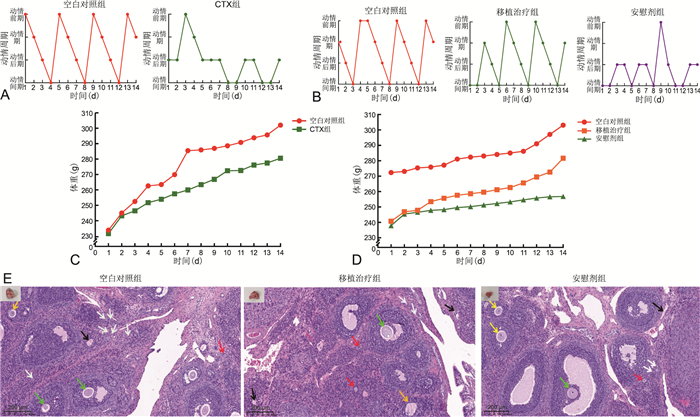
图 1 实验期间大鼠动情周期、体重变化趋势及卵巢组织形态学变化
注:A为建模期间2组大鼠动情周期变化;B为建模期间2组大鼠体重变化;C为干预期间3组大鼠动情周期变化;D为干预期间3组大鼠体重变化;E为卵巢病理组织形态(HE染色,×100),白色箭头示原始卵泡,红色箭头示初级卵泡,黄色箭头示次级卵泡,绿色箭头示窦状卵泡,黑色箭头示闭锁卵泡。
Figure 1. Estrous cycle, weight change trend and ovarian histomorphological changes of rats during the experimental period
表 1 建模后2组大鼠体重及血清性激素比较(x±s)
Table 1. Comparison of body weight and serum sex hormones between the two groups after modeling (x±s)
组别 只数 第14天体重
(g)LH
(mIU/mL)FSH
(mIU/mL)AMH
(pg/mL)E2
(pmol/L)空白对照组 8 302.44±9.69 18.60±2.96 18.72±2.36 4 646.82±347.06 45.88±4.19 CTX组 16 267.94±12.63 53.92±3.72 39.42±3.48 2 075.34±252.96 14.19±0.98 t值 7.566 24.790 15.871 23.852 29.312 P值 < 0.001 < 0.001 < 0.001 < 0.001 < 0.001  下载: 导出CSV
表 2 干预后3组大鼠体重及血清性激素比较(x±s)
Table 2. Comparison of body weight and serum sex hormones among the three groups after intervention (x±s)
组别 只数 第14天体重(g) LH(mIU/mL) FSH(mIU/mL) AMH(pg/mL) E2(pmol/L) 空白对照组 8 313.38±8.94 18.77±3.97 18.94±2.39 4 628.28±202.52 43.36±5.62 移植治疗组 8 289.56±10.80a 37.04±3.81a 28.28±2.24a 3 728.38±315.32a 29.96±3.68a 安慰剂组 8 280.82±4.40ab 53.88±3.54ab 39.37±3.05ab 2 251.86±441.78ab 14.23±0.68ab F值 55.301 118.032 111.889 94.247 111.828 P值 < 0.001 < 0.001 < 0.001 < 0.001 < 0.001 注:与空白对照组比较,aP < 0.05;与移植治疗组比较,bP < 0.05。
下载: 导出CSV
表 3 干预后3组大鼠卵巢各级卵泡数量比较(x±s, 个)
Table 3. Comparison of the number of ovarian follicles at all levels in the three groups after intervention (x±s, number)
组别 只数 原始卵泡 初级卵泡 次级卵泡 窦状卵泡 空白对照组 8 10.13±1.89 7.25±2.12 7.15±1.62 7.13±2.90 移植治疗组 8 6.63±1.69a 5.13±1.13a 4.13±1.89a 3.38±2.07a 安慰剂组 8 2.63±1.85ab 1.25±1.04ab 0.75±0.71ab 1.13±0.83ab F值 34.477 32.478 29.651 16.486 P值 < 0.001 < 0.001 < 0.001 < 0.001 注:与空白对照组比较,aP < 0.05;与移植治疗组比较,bP < 0.05。
下载: 导出CSV
表 4 3组大鼠卵巢组织Bcl-2和Bax蛋白浓度比较(x±s, ng/mL)
Table 4. Comparison of Bcl-2 and Bax protein concentrations in ovarian tissue of rats in three groups (x±s, ng/mL)
组别 只数 Bcl-2 Bax 空白对照组 8 151.52±9.44 7.95±0.42 移植治疗组 8 128.31±2.81a 8.78±0.64a 安慰剂组 8 97.53±3.33ab 9.70±0.63ab F值 129.183 16.403 P值 < 0.001 < 0.001 注:与空白对照组比较,aP < 0.05;与移植治疗组比较,bP < 0.05。
下载: 导出CSV
-
[1] CHON S J, UMAIR Z, YOON M S. Premature ovarian insufficiency: past, present, and future[J]. Front Cell Dev Biol, 2021, 9: 672890. DOI: 10.3389/fcell.2021.672890. [2] TORREALDAY S, KODAMAN P, PAL L. Premature ovarian insufficiency an update on recent advances in understanding and management[J]. F1000res, 2017, 6: 2069. DOI: 10.12688/f1000research.11948.1. [3] 程贤鹦, 王园园, 张朋辉, 等. 三孩政策后孕产妇妊娠特征、分娩方式和围生儿结局的临床研究[J]. 中华全科医学, 2024, 22(3): 451-454. doi: 10.16766/j.cnki.issn.1674-4152.003424CHENG X Y, WANG Y Y, ZHANG P H, et al. Study on pregnancy characteristics, delivery modes, and perinatal outcomes of after three-child Policy[J]. Chinese Journal of General Practice, 2024, 22(3): 451-454. doi: 10.16766/j.cnki.issn.1674-4152.003424 [4] ZAFARDOUST S, KAZEMNEJAD S, DARZI M, et al. Intraovarian administration of autologous menstrual blood derived-mesenchymal stromal cells in women with premature ovarian failure[J]. Arch Med Res, 2023, 54(2): 135-144. doi: 10.1016/j.arcmed.2022.12.015 [5] YONG T Y, WANG D D, LI X, et al. Extracellular vesicles for tumor targeting delivery based on five features principle[J]. J Contr Release, 2020, 322(4): 555-565. [6] VIZOSO F J, EIRO N, CID S, et al. Mesenchymal stem cell secretome: toward cell-free therapeutic strategies in regenerative medicine[J]. Int J Mol Sci, 2017, 18(9): 1852. DOI: 10.3390/ijms18091852. [7] GENG Z X, CHEN H Y, ZOU G, et al. Human amniotic fluid mesenchymal stem cell-derived exosomes inhibit apoptosis in ovarian granulosa cell via miR-369-3p/yaf2/pdcd5/p53 pathway[J]. Oxid Med Cell Longev, 2022: 3695848. DOI: 10.1155/2022/3695848. [8] DING C Y, ZHU L P, SHEN H, et al. Exosomal mirna-17-5p derived from human umbilical cord mesenchymal stem cells improves ovarian function in premature ovarian insufficiency by regulating sirt7[J]. Stem Cells, 2020, 38(9): 1137-1148. [9] ZHANG S H, YAHAYA B H, PAN Y, et al. Menstrual blood-derived endometrial stem cell, a unique and promising alternative in the stem cell-based therapy for chemotherapy-induced premature ovarian insufficiency[J]. Stem Cell Res Ther, 2023, 14(1): 327. DOI: 10.1186/s13287-023-03551-w. [10] AHMADIAN S, MAHDIPOUR M, PAZHANG M, et al. Effectiveness of stem cell therapy in the treatment of ovarian disorders and female infertility: a systematic review[J]. J Curr Stem Cell Res Ther, 2020, 15(2): 173-186. doi: 10.2174/1574888X14666191119122159 [11] HADE M D, SUIRE C N, SUO Z C. Mesenchymal stem cell-derived exosomes: applications in regenerative medicine[J]. Cells, 2021, 10(8): 1959. DOI: 10.3390/cells10081959. [12] 刘勃彤, 刘东哲, 陈秀慧. 月经血干细胞来源外泌体在疾病治疗中的应用[J]. 国际妇产科学杂志, 2021, 48(5): 592-596.LIU B T, LIU D Z, CHEN X H. Progress in clinical treatment of menstrual blood stem cell-derived exosomes[J]. Journal of International Obstetrics and Gynecology, 2021, 48(5): 592-596. [13] LIU M Y, QIU Y, XUE Z W, et al. Small extracellular vesicles derived from embryonic stem cells restore ovarian function of premature ovarian failure through PI3K/AKT signaling pathway[J]. Stem Cell Res Ther, 2020, 11(1): 3. DOI: 10.1186/s13287-019-1508-2. [14] BEDENK J, VRTAČNIK-BOKAL E, VIRANT-KLUN I. The role of anti-Müllerian hormone (AMH) in ovarian disease and infertility[J]. Assist Reprod Genet, 2020, 37(1): 89-100. [15] SUN B, MA Y J, WANG F, et al. MiR-644-5p carried by bone mesenchymal stem cell-derived exosomes targets regulation of p53 to inhibit ovarian granulosa cell apoptosis[J]. Stem Cell Res Ther, 2019, 10(1): 360. DOI: 10.1186/s13287-019-1442-3. [16] CHEN L J, QU J J, XIANG C L. The multi-functional roles of menstrual blood-derived stem cells in regenerative medicine[J]. Stem Cell Res Ther, 2019, 10(1): 1. DOI: 10.1186/s13287-018-1105-9. [17] SANCHEZ-MATA A, GONZALEZ-MUÑOZ E. Understanding menstrual blood-derived stromal/stem cells: definition and properties. Are we rushing into their therapeutic applications?[J]. iScience, 2021, 24(12): 103501. DOI: 10.1016/j.isci.2021.103501. [18] ZHANG S W, HUANG B X, SU P, et al. Concentrated exosomes from menstrual blood-derived stromal cells improves ovarian activity in a rat model of premature ovarian insufficiency[J]. Stem Cell Res Ther, 2021, 12(1): 178. DOI: 10.1186/s13287-021-02255-3. [19] DING C Y, QIAN C F, HOU S Y, et al. Exosomal miRNA-320a is released from hAMSCs and regulates SIRT4 to prevent reactive oxygen species generation in POI[J]. Mol Ther Nucleic Acids, 2020, 21: 37-50. [20] YANG M L, LIN L, SHA C L, et al. Bone marrow mesenchymal stem cell-derived exosomal miR-144-5p improves rat ovarian function aster chemotherapy-induced ovarian failure by targeting PTEN[J]. Lab Invest, 2020, 100(3): 342-352. -

 点击查看大图
计量
- 文章访问数: 14
- HTML全文浏览量: 9
- PDF下载量: 1
- 被引次数: 0
