



Identification of HTR1D as a therapeutic target and prognostic indicator for colorectal cancer
-
摘要:
目的 通过生物信息学方法筛选鉴定结直肠癌差异基因,探讨5-羟色胺受体1D(5-HTR1D)在结直肠癌中的作用及价值。 方法 利用GEO数据集识别结直肠癌和癌旁正常组织中的差异表达基因(DEGs)。建立蛋白质互作网络,鉴定与结直肠癌相关的关键基因。收集结直肠癌及癌旁组织进行免疫组化,对不同的结直肠癌细胞系进行Western blotting验证HTR1D的差异。通过GO和KEGG富集分析探讨与HTR1D相关的信号通路。采用Kaplan-Meier生存分析和多因素Cox回归分析研究HTR1D表达与结直肠癌患者临床病理特征和预后的关系。建立小鼠异种移植模型,体内实验验证HTR1D作为CRC治疗靶点的有效性。 结果 HTR1D在结直肠癌组织中表达显著上调,且主要表达于肿瘤细胞胞质中。Western blotting检测证实在结直肠癌中,HTR1D在低分化细胞系中高表达。临床病理分析证实HTR1D的表达与CRC患者的肿瘤大小(P=0.044)、高血压(P=0.039)显著相关。Kaplan-Meier生存分析[(18.9±2.5)月vs. (26.7±1.9)月,P=0.033]和多因素Cox回归分析表明HTR1D的表达是CRC患者预后的影响因素(P=0.019,HR=1.159,95% CI:1.024~1.312)。体内实验显示抑制HTR1D表达可降低肿瘤的质量和体积。 结论 HTR1D可作为结直肠癌的治疗靶点和预后指标。 Abstract:Objective To screen and identify differential genes in colorectal cancer by bioinformatics, and to explore the role and value of 5-hydroxytryptamine receptor 1D (5-HTR1D) in colorectal cancer. Methods The differentially expressed genes (DEGs) between colorectal cancer and adjacent normal tissues were identified in this study by using GEO data set. Subsequently, a protein-protein interaction network and key genes related to colorectal cancer were established. Tissue samples from colorectal cancer and adjacent tissues were collected for immunohistochemistry, and different colorectal cancer cell lines were subjected to Western blotting to verify the differences of HTR1D. The potential mechanism of HTR1D was discussed by GO and KEGG enrichment analysis. Kaplan-Meier survival analysis and multivariate Cox regression analysis were used to verify the correlation between HTR1D expression and the clinicopathological features and prognosis of patients with colorectal cancer. A mouse xenotransplantation model was established, and the effectiveness of HTR1D as a target for CRC treatment was verified by in vivo experiments. Results The results of the present study demonstrated that the expression of HTR1D was considerably upregulated in CRC tissue, and was principally expressed in the cytoplasm of tumor cells. Western blotting assay was performed to detect HTR1D expression in CRC cell lines: HTR1D was highly expressed in poorly differentiated cell lines. From clinical aspects, HTR1D expression was significantly correlated with tumor size (P=0.044)and hypertension(P=0.039) in CRC. Kaplan-Meier survival analysis [(18.9±2.5) mouths vs. (26.7±1.9) mouths, P=0.033] and multivariate Cox regression analysis indicated that the expression of HTR1D was closely associated with the prognosis of patients (P=0.019, HR=1.159, 95% CI: 1.024-1.312). In vivo experiments demonstrate that the inhibition of HTR1D expression results in a reduction of expression level in a reduction in the mass and volume of tumors. Conclusion HTR1D has been identified as both a viable therapeutic target and a prognostic indicator in colorectal cancer cases. -

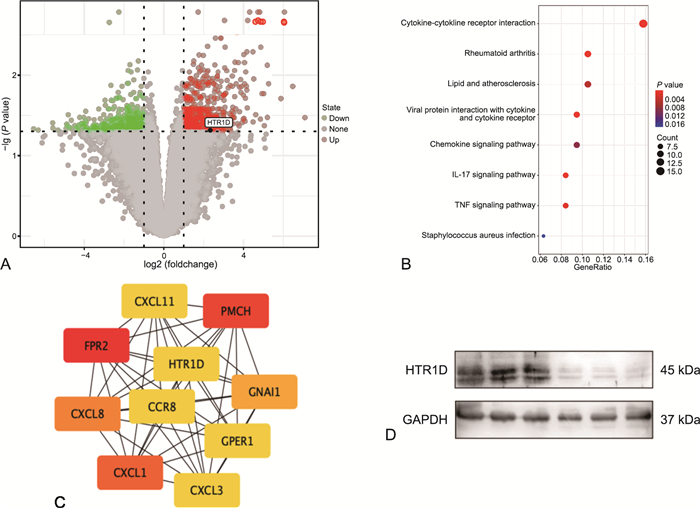
图 1 CRC中差异基因筛选及生物信息学分析
注:A为DEGs火山图,红色代表上调的基因,绿色代表下调的基因。HTR1D: log(FC)=2.297,P=0.048;B为DEGs的KEGG分析;C为DEGs的PPI网络分析;D为HTR1D在CRC细胞中的表达。
Figure 1. Screening of differential genes in CRC and bioinformatics analysis

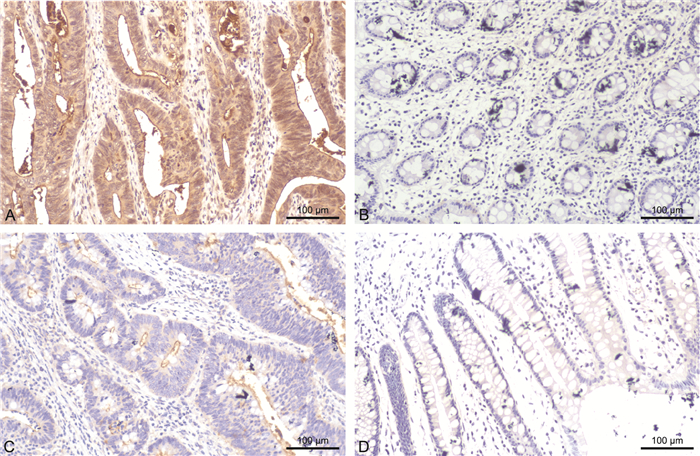
图 2 CRC患者HTR1D的免疫组织化学染色(×200)
注:A为HTR1D高表达的癌组织;B为HTR1D高表达的配对癌旁组织;C为HTR1D低表达的癌组织;D为HTR1D低表达的配对癌旁组织。
Figure 2. Immunohistochemical staining of HTR1D in CRC patients (×200)

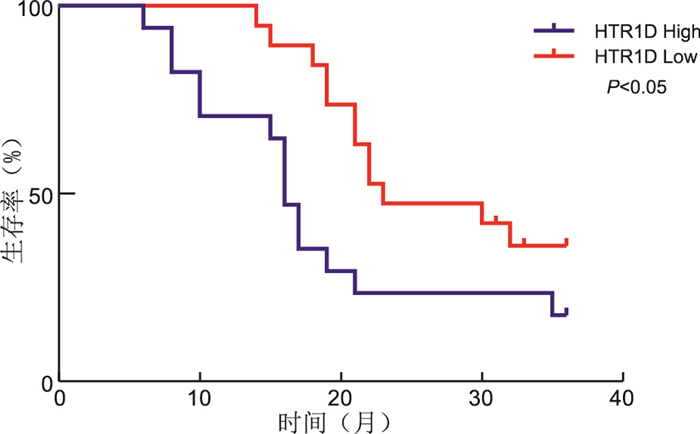
图 3 不同HTR1D表达情况CRC患者KM生存分析
注:红色和蓝色分别代表低和高表达组(P=0.033)。
Figure 3. KM survival analysis of CRC patients with different HTR1D expression
表 1 不同临床病理特征CRC患者HTR1D表达情况比较(例)
Table 1. Comparison of HTR1D expression in CRC patients with different clinicopathological features (cases)
项目 例数 HTR1D高表达
(n=17)HTR1D低表达
(n=19)P值a 性别 0.158 男性 24 9 15 女性 12 8 4 年龄 0.192 >69岁 21 12 9 ≤69岁 15 5 10 高血压 0.039 无 22 7 15 有 14 10 4 糖尿病 0.434 无 29 13 16 有 7 4 3 心肺疾病 0.999 无 29 14 15 有 7 3 4 ASA分级 0.629 1 13 6 7 2 15 6 9 3 8 5 3 远处转移 0.999 无 26 12 14 有 10 5 5 CEA 0.335 阳性(≥5 ng/mL) 20 11 9 阴性(< 5 ng/mL) 16 6 10 CA199 0.706 阳性(≥37 U/mL) 9 5 4 阴性(< 37 U/mL) 27 12 15 肿瘤最大径 0.044 >4.5 cm 18 12 6 ≤4.5 cm 18 5 13 分化程度 0.413 高分化 10 4 6 中分化 19 8 11 低分化 7 5 2 淋巴结转移 0.505 >2个 18 7 11 ≤2个 18 10 8 病理分期 0.552 Ⅰ期 2 2 0 Ⅱ期 5 2 3 Ⅲ期 19 8 11 Ⅳ期 10 5 5 术前白蛋白 0.177 阳性(< 40 g/L) 13 4 9 阴性(≥40 g/L) 23 13 10 Ki67 0.684 >80% 7 4 3 ≤80% 29 13 16 注:a组间比较均使用Fisher精确检验。  下载: 导出CSV
表 2 各变量赋值情况
Table 2. Assignment methods of variables
变量 赋值方法 死亡 否=0,是=1 性别 男性=0,女性=1 年龄 ≤69岁=0,>69岁=1 CA199 <5 ng/mL=0,≥5 ng/mL=1 CEA <37 U/mL=0,≥37 U/mL=1 淋巴结转移 <2个=0,≥2个=1 病理分期 Ⅰ期=0,Ⅱ期=1,Ⅲ期=2,Ⅳ期=3 肿瘤位置 左半结肠=0,右半结肠=1 HTR1D 低表达=0,高表达=1
下载: 导出CSV
表 3 影响结肠癌患者预后的多因素Cox回归分析
Table 3. Cox regression multivariate analysis of prognosis of colon cancer patients
变量 SE Waldχ2 P值 HR值 95% CI 性别 0.457 2.254 0.133 0.503 0.206~1.233 年龄 0.023 0.002 0.963 0.999 0.955~1.045 CA199 0.001 7.608 0.006 1.002 1.001~1.003 CEA 0.018 0.133 0.716 1.007 0.971~1.043 淋巴结转移 0.062 1.690 0.194 1.084 0.960~1.224 病理分期 0.310 0.575 0.448 1.265 0.689~2.320 肿瘤位置 0.535 3.876 0.049 2.869 1.005~8.195 HTR1D 0.063 5.459 0.019 1.159 1.024~1.312
下载: 导出CSV
-
[1] FILHO A M, LAVERSANNE M, FERLAY J, et al. The GLOBOCAN 2022 cancer estimates: data sources, methods, and a snapshot of the cancer burden worldwide[J]. Int J Cancer, 2025, 156(7): 1336-1346. doi: 10.1002/ijc.35278 [2] 张丽, 凌晨, 沈轶骊. 血清microRNA-21、microRNA-193a-3p表达与结直肠癌患者手术预后的关系[J]. 中国现代医学杂志, 2024, 34(5): 1-6.ZHANG L, LING C, SHEN Y L. The relationship of preoperative serum microRNA-21, microRNA-193a-3p levels with postoperative prognosis of colorectal cancer patients[J]. China Journal of Modern Medicine, 2024, 34(5): 1-6. [3] CAO J L, YANG X, CHEN S Y, et al. The predictive efficacy of tumor mutation burden in immunotherapy across multiple cancer types: a meta-analysis and bioinformatics analysis[J]. Transl Oncol, 2022, 20: 101375. DOI: 10.1016/j.tranon.2022.101375. [4] SINGH D, SINGH P, SRIVASTAVA P, et al. Development and challenges in the discovery of 5-HT1A and 5-HT7 receptor ligands[J]. Bioorg Chem, 2023, 131: 106254. DOI: 10.1016/j.bioorg.2022. [5] ZHANG Y Y, MAO M H, HAN Z X. Identification of a gene prognostic signature for oral squamous cell carcinoma by RNA sequencing and bioinformatics[J]. Biomed Res Int, 2021: 6657767. DOI: 10.1155/2021/6657767. [6] 曾薇, 唐菊彬, 陈向宙, 等. 基于癌症免疫周期筛选结直肠癌免疫联合治疗的新靶点[J]. 中华全科医学, 2025, 23(1): 31-35, 147. doi: 10.16766/j.cnki.issn.1674-4152.003829ZENG W, TANG J B, CHEN X Z, et al. Screening novel targets for combination immunotherapy of colorectal cancer based on cancer immune cycle[J]. Chinese Journal of General Practice, 2025, 23(1): 31-35, 147. doi: 10.16766/j.cnki.issn.1674-4152.003829 [7] MURPHY C C, ZAKI T A. Changing epidemiology of colorectal cancer: birth cohort effects and emerging risk factors[J]. Nat Rev Gastroenterol Hepatol, 2024, 21(1): 25-34. doi: 10.1038/s41575-023-00841-9 [8] JIANG C, ZHOU Q J, YI K, et al. Colorectal cancer initiation: understanding early-stage disease for intervention[J]. Cancer Lett, 2024, 589: 216831. DOI: 10.1016/j.canlet.2024.216831. [9] ZHANG J L, CHEN B N, LI H, et al. Cancer-associated fibroblasts potentiate colorectal cancer progression by crosstalk of the IGF2-IGF1R and Hippo-YAP1 signaling pathways[J]. J Pathol, 2023, 259(2): 205-219. doi: 10.1002/path.6033 [10] PENG D D, FU M Y, WANG M N, et al. Targeting TGF-β signal transduction for fibrosis and cancer therapy[J]. Mol Cancer, 2022, 21(1): 104. DOI: 10.1186/s12943-022-01569-x. [11] MELLMAN I, CHEN D S, POWLES T, et al. The cancer-immunity cycle: indication, genotype, and immunotype[J]. Immunity, 2023, 56(10): 2188-2205. doi: 10.1016/j.immuni.2023.09.011 [12] ZHANG Y E, STUELTEN C H. Alternative splicing in EMT and TGF-β signaling during cancer progression[J]. Semin Cancer Biol, 2024, 101: 1-11. [13] 边晓倩, 王莎莎, 赵淑芬, 等. Ⅲ期结直肠癌血清细胞因子水平与术后短期复发关系[J]. 青岛大学学报(医学版), 2024, 60(1): 72-76.BIAN X Q, WANG S S, ZHAO S F, et al. Association between serum cytokine levels and postoperative short-term recurrence in patients with stageⅢcolorectal cancer[J]. Journal of Qingdao University(Medical Sciences), 2024, 60(1): 72-76. [14] KHARE T, BISSONNETTE M, KHARE S. CXCL12-CXCR4/CXCR7 axis in colorectal cancer: therapeutic target in preclinical and clinical studies[J]. Int J Mol Sci, 2021, 22(14): 7371. DOI: 10.3390/ijms22147371. [15] DENK D, RAMAKRIISHAN M, CONCHE C, et al. IL-17RA signaling provides dual tumor-suppressor function during late-stage colorectal carcinogenesis[J]. Immunity, 2025, 58(3): 701-715. e8. doi: 10.1016/j.immuni.2025.02.005 [16] BALAKRISHNA P, GEORGE S, HATOUM H, et al. Serotonin pathway in cancer[J]. Int J Mol Sci, 2021, 22(3): 1268. DOI: 10.3390/ijms22031268. -

 点击查看大图
计量
- 文章访问数: 14
- HTML全文浏览量: 6
- PDF下载量: 2
- 被引次数: 0
