



Value of serum neurofilament light chain and glial fibrillary acidic protein levels in predicting neurological recovery and prognosis in patients with acute cerebral infarction
-
摘要:
目的 探讨血清神经丝轻链(NfL)和胶质纤维酸性蛋白(GFAP)水平对急性脑梗死(AIS)患者神经损伤和修复的影响,为个体化治疗提供依据。 方法 纳入2020年1月—2022年12月河南科技大学第一附属医院收治的129例AIS患者,根据出院后3个月改良Rankin(mRS)评分将患者分为预后良好组(mRS评分≤2分,83例)和预后不良组(mRS评分>2分,46例)。分析2组患者临床特征和NfL、GFAP水平的差异,评估两者的预后预测价值,分析AIS患者神经功能不良预后的危险因素。 结果 与预后良好组比较,预后不良组NfL(15.2±6.3 vs. 22.8±8.5,t=5.777,P<0.001)和GFAP[0.85(0.62, 1.18) vs. 1.12(0.79, 1.45),U=1 254.000,P=0.003]水平升高,两者与患者美国国立卫生研究院卒中量表(NIHSS)评分和梗死体积呈正相关关系。血清NfL(OR=1.861,95% CI: 1.076~3.220,P=0.024)和GFAP(OR=2.979,95% CI: 1.428~6.218,P=0.004)升高是AIS患者预后不良的独立影响因素。两者联合检测可以提高预测AIS患者神经功能预后的准确性(AUC=0.809)。 结论 联合检测NfL和GFAP水平有助于早期识别神经功能不良的AIS患者,指导个体化治疗方案的制定。 Abstract:Objective To investigate the impact of serum neurofilament light chain (NfL) and glial fibrillary acidic protein (GFAP) levels on neurological injury and recovery in acute ischemic stroke (AIS) patients, providing evidence for personalized treatment. Methods A total of 129 AIS patients admitted to our hospital from January 2020 to December 2022 were included. According to the modified Rankin scale (mRS) score at 3 months post-discharge, patients were divided into a good prognosis group (mRS≤2, 83 cases) and a poor prognosis group (mRS>2, 46 cases). The clinical characteristics and serum levels of NfL and GFAP were compared between the two groups. The prognostic predictive value of these biomarkers and risk factors for poor neurological outcomes in AIS patients were analyzed. Results Compared with the good prognosis group, the poor prognosis group had significantly higher levels of NfL (15.2±6.3 vs. 22.8±8.5, t=5.777, P < 0.001) and GFAP [0.85 (0.62, 1.18) vs. 1.12 (0.79, 1.45), U=1 254.000, P=0.003], both of which were positively correlated with NIHSS scores and infarct volume. Multivariate regression analysis showed that elevated NfL (OR=1.861, 95% CI: 1.076-3.220, P=0.024) and GFAP (OR=2.979, 95% CI: 1.428-6.218, P=0.004) were independent influencing factors for poor prognosis in AIS patients. The combined detection of NfL and GFAP demonstrated higher predictive accuracy for neurological outcomes (AUC=0.809) compared to single biomarker detection. Conclusion Combined detection of serum NfL and GFAP levels is useful for early identification of AIS patients at risk of poor neurological outcomes and provides evidence for developing personalized treatment strategies. -

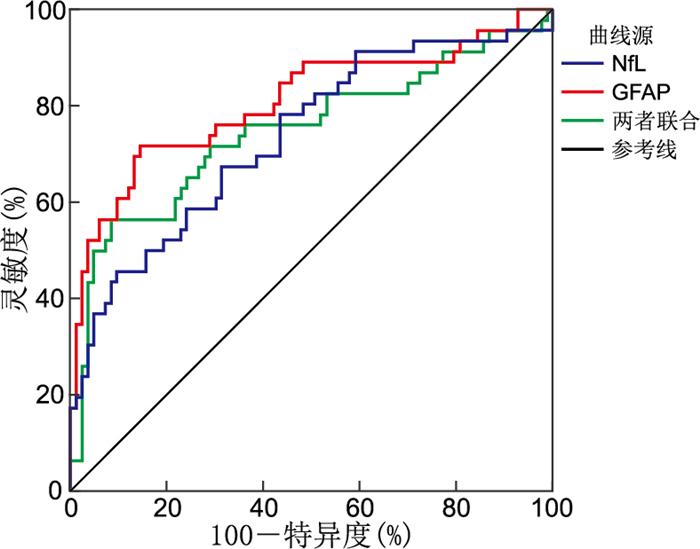
图 1 血清NfL和GFAP对脑梗死患者神经功能不良预后的ROC曲线
Figure 1. ROC curves of serum NfL and GFAP for poor prognosis of neurological function in patients with cerebral infarction
表 1 预后良好组和预后不良组临床特征比较
Table 1. Comparison of clinical characteristics between good and poor prognosis groups
临床特征 预后良好组
(n=83)预后不良组
(n=46)统计量 P值 年龄(x±s,岁) 63.5±10.8 65.2±12.1 0.820a 0.414 性别(男性/女性,例) 51/32 27/19 0.062b 0.803 BMI(x±s) 24.3±3.1 24.8±3.5 0.838a 0.404 吸烟史[例(%)] 32(38.6) 18(39.1) 0.002b 0.964 饮酒史[例(%)] 25(30.1) 13(28.3) 0.031b 0.860 高血压病史[例(%)] 58(69.9) 34(73.9) 0.213b 0.644 糖尿病史[例(%)] 35(42.2) 19(41.3) 0.008b 0.928 房颤史[例(%)] 12(14.5) 7(15.2) 0.016b 0.899 梗死部位(前循环/后循环,例) 61/22 33/13 0.032b 0.858 梗死类型[例(%)] 0.256b 0.613 大动脉粥样硬化 36(43.4) 19(41.3) 心源性栓塞 27(32.6) 11(23.9) 小动脉闭塞 10(12.0) 8(17.4) 其他病因 8(9.6) 5(10.9) 原因不明型 2(2.4) 3(6.5) 入院时NIHSS评分(x±s,分) 7.2±3.5 10.5±4.1 4.821a <0.001 梗死体积(x±s,mL) 22(13, 38) 36(21, 53) 812.500c 0.002 治疗方案[例(%)] 0.618b 0.358 药物治疗 61(73.5) 30(65.2) 介入治疗 22(26.5) 16(34.8) 发病到入院时间(x±s,h) 4.8±1.3 5.2±1.1 1.110a 0.269 住院期间并发症[例(%)] 15(18.1) 18(39.1) 5.832b 0.016 注:a为t值,b为χ2值,c为U值。  下载: 导出CSV
表 2 预后良好组和预后不良组AIS患者血清NfL、GFAP水平比较
Table 2. Comparison of serum NfL and GFAP levels between good and poor prognosis groups of AIS patients
组别 例数 NfL
(x±s,pg/mL)GFAP
[M(P25, P75),ng/mL]预后良好组 83 15.2±6.3 0.85(0.62, 1.18) 预后不良组 46 22.8±8.5 1.12(0.79, 1.45) 统计量 5.777a 1 254.000b P值 <0.001 0.003 注:a为t值,b为U值。
下载: 导出CSV
表 3 急性脑梗死患者神经功能恢复不良影响因素的logistic回归分析
Table 3. Logistic regression analysis of factors influencing poor neurological function recovery in patients with acute cerebral infarction
变量 B SE Waldχ2 P值 OR值 95% CI 年龄 0.712 0.435 2.680 0.101 2.038 0.892~4.659 性别 0.509 0.415 1.503 0.220 1.663 0.782~3.537 入院时NIHSS评分 1.278 0.632 4.092 0.043 3.590 1.027~12.541 梗死体积 1.045 0.366 8.163 0.004 2.844 1.415~5.709 血清NfL 0.621 0.275 5.095 0.024 1.861 1.076~3.220 血清GFAP 1.092 0.389 7.893 0.004 2.979 1.428~6.218 发病至入院时间 0.302 0.467 0.418 0.518 1.352 0.491~3.723 住院期间并发症 1.143 0.423 7.303 0.007 3.137 1.376~7.155 注:变量赋值如下,入院时NIHSS评分、梗死体积、血清NfL、血清GFAP发病至入院时间均为连续型变量,以实际值赋;住院期间并发症(有=1,无=0)。
下载: 导出CSV
表 4 血清NfL和GFAP对脑梗死患者神经功能不良预后的诊断效能
Table 4. Diagnostic efficacy of serum NfL and GFAP for poor neurological outcome in patients with cerebral infarction
项目 AUC(95% CI) 灵敏度
(%)特异度
(%)最佳临界值 约登指数 Z值 P值 NfL 0.736(0.651~0.810) 67.39 68.67 18.4 pg/mL 0.361 4.957 <0.001 GFAP 0.749(0.665~0.821) 56.52 91.57 1.17 ng/mL 0.481 5.014 <0.001 联合检测 0.809(0.731~0.873) 74.74 85.54 0.573 6.984 <0.001
下载: 导出CSV
-
[1] ZHAO Y F, ZHANG X J, CHEN X Y, et al. Neuronal injuries in cerebral infarction and ischemic stroke: from mechanisms to treatment (Review)[J]. Int J Mol Med, 2022, 49(2). DOI: 10.3892/ijmm.2021.5070. [2] WEN F, YU L Z, XIA C C, et al. Development and study of S100 calcium-binding protein B and neuron-specific enolase-based predictive model for epilepsy secondary to cerebral infarction[J]. Cell Mol Biol, 2022, 68(10): 130-135. doi: 10.14715/cmb/2022.68.10.21 [3] ZANG Y J, ZHENG H W, LIU S L, et al. Assessment and prognostic value of serum uric acid and neuron-specific enolase on the efficacy of intravenous thrombolytic therapy in cerebral infarction[J]. Pak J Pharm Sci, 2023, 36[4(Special)]: 1325-1330. [4] ABU-RUMEILEH S, ABDELHAK A, FOSCHI M, et al. The multifaceted role of neurofilament light chain protein in non-primary neurological diseases[J]. Brain, 2023, 146(2): awac328. DOI: 10.1093/brain/awac328. [5] 杨家发, 陆兆丰, 王亚琼, 等. 吡咯烷二硫代氨基甲酸铵对创伤性脑损伤大鼠神经炎症的作用及机制[J]. 新乡医学院学报, 2024, 41(7): 631-639.YANG J F, LU Z F, WANG Y Q, et al. Effect and mechanism of ammonium pyrrolidine dithiocarbamate on neuroinflammation in rats with traumatic brain injury[J]. Journal of Xinxiang Medical University, 2024, 41(7): 631-639. [6] 黎昌炫, 朱娴, 陈奕斌, 等. 脑小血管病患者血清NFL、GFAP水平与睡眠障碍的关系[J]. 脑与神经疾病杂志, 2024, 32(7): 405-408.LI C X, ZHU X, CHEN Y B, et al. Relationship between serum NFL, GFAP and sleep disorders in patients with small cerebral vascular disease[J]. Journal of Brain and Nervous Diseases, 2024, 32(7): 405-408. [7] 中华医学会神经病学分会, 中华医学会神经病学分会脑血管病学组, 彭斌, 等. 中国急性缺血性脑卒中诊治指南2018[J]. 中华神经科杂志, 2018, 51(9): 666-682.Chinese Society of Neurology, Chinese Society of Neurology, Chinese Society of Cerebrovascular Disease. Chinese guidelines for diagnosis and treatment of acute ischemic stroke 2018[J]. Chinese Journal of Neurology, 2018, 51(9): 666-682. [8] 马超, 刘莉, 邓光璞, 等. 基于CHAID模型的广州市某街道高血压患者生活方式影响因素分析[J]. 中华全科医学, 2023, 21(5): 788-791. doi: 10.16766/j.cnki.issn.1674-4152.002984MA C, LIU L, DENG G P, et al. CHAID model-based analysis of influencing factors of hypertensive patients' lifestyle on a street in Guangzhou[J]. Chinese Journal of General Practice, 2023, 21(5): 788-791. doi: 10.16766/j.cnki.issn.1674-4152.002984 [9] HENDRIX P, MELAMED I, COLLINS M, et al. NIHSS 24 h after mechanical thrombectomy predicts 90-day functional outcome[J]. Clin Neuroradiol, 2022, 32(2): 401-406. doi: 10.1007/s00062-021-01068-4 [10] HAGGAG H, HODGSON C. Clinimetrics: modified rankin scale (mRS)[J]. J Physiother, 2022, 68(4): 281. DOI: 10.1016/j.jphys.2022.05.017. [11] GE X Y, XU C, DAI J S, et al. Bidirectional remodeling of the central auditory system caused by unilateral auditory deprivation[J]. Front Neurol, 2024, 15: 1414738. DOI: 10.3389/fneur.2024.1414738. [12] AMALIA L. Glial fibrillary acidic protein (GFAP): neuroinflammation biomarker in acute ischemic stroke[J]. J Inflamm Res, 2021, 14: 7501-7506. doi: 10.2147/JIR.S342097 [13] SAHRAI H, NOROUZI A, HAMZEHZADEH S, et al. SIMOA-based analysis of plasma NFL levels in MCI and AD patients: a systematic review and meta-analysis[J]. BMC Neurol, 2023, 23(1): 331. DOI: 10.1186/s12883-023-03377-2. [14] WANG J H, HUANG J, GUO F Q, et al. Circulating neurofilament light predicts cognitive decline in patients with post-stroke subjective cognitive impairment[J]. Front Aging Neurosci, 2021, 13: 665981. DOI: 10.3389/fnagi.2021.665981. [15] DELABY C, JULIAN A, PAGE G, et al. NFL strongly correlates with TNF-R1 in the plasma of AD patients, but not with cognitive decline[J]. Sci Rep, 2021, 11(1): 10283. DOI: 10.1038/s41598-021-89749-5. [16] PELKMANS W, SHEKARI M, BRUGULAT-SERRAT A, et al. Astrocyte biomarkers GFAP and YKL-40 mediate early Alzheimer' s disease progression[J]. Alzheimers Dement, 2024, 20(1): 483-493. doi: 10.1002/alz.13450 [17] WANG A Y, LEUNG L Y, PUTTOCK E J, et al. Retraction Statement[J]. Cerebrovasc Dis, 2024, 53(3): 361. [18] FERRARI F, ROSSI D, RICCIARDI A, et al. Quantification and prospective evaluation of serum NfL and GFAP as blood-derived biomarkers of outcome in acute ischemic stroke patients[J]. J Cereb Blood Flow Metab, 2023, 43(9): 1601-1611. doi: 10.1177/0271678X231172520 [19] JURGA A M, PALECZNA M, KADLUCZKA J, et al. Beyond the GFAP-astrocyte protein markers in the brain[J]. Biomolecules, 2021, 11(9): 1361. DOI: 10.3390/biom11091361. [20] ABDELHAK A, FOSCHI M, ABU-RUMEILEH S, et al. Blood GFAP as an emerging biomarker in brain and spinal cord disorders[J]. Nat Rev Neurol, 2022, 18(3): 158-172. -

 点击查看大图
计量
- 文章访问数: 8
- HTML全文浏览量: 1
- PDF下载量: 0
- 被引次数: 0
