



Characteristics of gastric microbiota in patients with drug-resistant Helicobacter pylori infection
-
摘要:
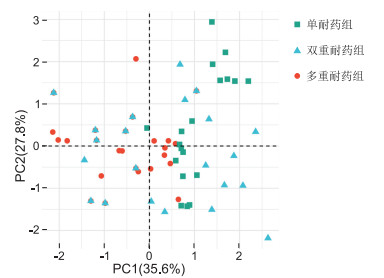
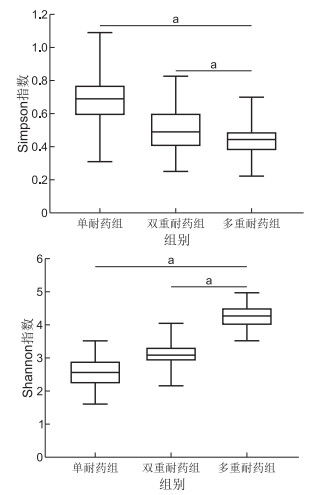
目的 幽门螺旋杆菌感染与慢性胃炎、消化性溃疡、胃癌等多种胃部疾病的发生发展密切相关,其耐药机制复杂,传统根除方案失败率高,而胃内菌群可能通过调节局部微环境或介导抗生素代谢影响幽门螺杆菌耐药性。本研究旨在分析耐药性幽门螺旋杆菌感染患者胃内菌群特征。 方法 选取2023年1月—2024年6月浙江省人民医院淳安分院收治的幽门螺旋杆菌感染患者184例作为研究对象,均进行药敏检查,根据药敏检查结果分为单耐药组、双重耐药组和多重耐药组。所有患者均留取胃部组织样本,基于16S rRNA测序检测胃内菌群特征,包括α多样性(Simpson指数和Shannon指数)和β多样性(基于主成分分析),采用LEfSe分析筛选出各组间差异显著的菌属。 结果 3组患者α多样性的Shannon指数、Simpson指数比较差异均有统计学意义(P < 0.05), 其中单耐药组Shannon指数(2.54±0.45)最低, Simpson指数(0.67±0.15)最高, 多重耐药组Shannon指数(4.26±0.34)最高, Simpson指数(0.44±0.11)最低(P < 0.05)。主成分分析显示, 3组样本间多样性差异较大(35.6% vs. 27.8%)。 结论 不同耐药性幽门螺旋杆菌感染患者胃内菌群呈现出显著的多样性差异。 Abstract:Objective Helicobacter pylori (H. pylori) infection is closely related to the occurrence and development of various gastric diseases, such as chronic gastritis, peptic ulcer disease, and gastric cancer. However, its mechanisms of drug resistance are complex, and the failure rate of traditional eradication programs remains high. Emerging evidence suggests that the gastric microflora may affect H. pylori drug resistance by regulating the local microenvironment or mediating antibiotic metabolism. This study aimed to analyze the characteristics of the gastric bacterial flora in patients with drug-resistant H. pylori infection. Methods A total of 184 patients with Helicobacter pylori infection admitted to Chun' an Branch of Zhejiang Provincial People' s hospital from January 2023 to June 2024 were selected as the study objects, and all of them were tested for drug sensitivity. According to the results of drug susceptibility test, the patients were divided into the single-drug resistance group, the double-drug resistance group, and the multiple-drug resistance group. Gastric tissue samples were collected from all patients, and the characteristics of gastric microbiota were detected based on 16srRNA sequencing, including α diversity (Simpson index and Shannon index) and β diversity (based on principal component analysis). LEfSe analysis was used to identify bacteria genera with significant differences among all groups. Results Significant differences were observed in the alpha-diversity indices (Shannon and Simpson) among the three patient groups (P < 0.05). The mono-resistant group exhibited the lowest Shannon index (2.54±0.45) and the highest Simpson index (0.67±0.15), whereas the multidrug-resistant group demonstrated the highest Shannon index (4.26±0.34) and the lowest Simpson index (0.44±0.11), P < 0.05. Principal component analysis revealed considerable diversity disparities among the groups (35.6% vs. 27.8%). Conclusion The gastric microbiota composition and diversity differ significantly among patients with varying degrees of H. pylori drug resistance. -

图 1 3组幽门螺旋杆菌感染患者胃内菌群的α多样性箱式图
注:aP < 0.05。
Figure 1. Box plot showing α-diversity of the gastric microbiota across three groups of patients with H. pylori infection

图 2 3组幽门螺旋杆菌感染患者胃内菌群的β多样性
Figure 2. β-diversity of gastric microbiota in the three groups of patients with H. pylori infection

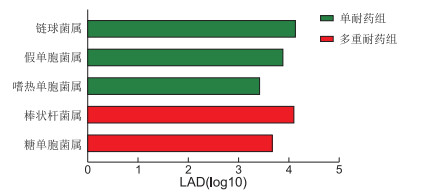
图 3 耐药性幽门螺旋杆菌感染患者胃内差异菌属分析
Figure 3. Analysis of gastric microbiota differences in patients with drug-resistant H. pylori infection
表 1 3组幽门螺旋杆菌感染患者胃内菌群的α多样性对比(x±s)
Table 1. Comparison of gastric microbiota α-diversity among the three groups of patients with H. pylori infection (x±s)
组别 例数 Shannon指数 Simpson指数 单耐药组 81 2.54±0.45 0.67±0.15 双重耐药组 75 3.13±0.36 0.50±0.13 多重耐药组 28 4.26±0.34 0.44±0.11 F值 195.739 44.142 P值 < 0.001 < 0.001  下载: 导出CSV
-
[1] 曹波. 抗幽门螺旋杆菌治疗辅助疗法在难治性特发性血小板减少性紫癜合并幽门螺旋杆菌感染中的应用[J]. 医药论坛杂志, 2021, 42(16): 45-48, 52.CAO B. Application of adjuvant treatment with anti-helicobacter pylori in refractory idiopathic thrombocytopenic purpura with helicobacter pylori infection[J]. Journal of Medical Forum, 2021, 42(16): 45-48, 52. [2] ROHHAS T, EKNEKTZOGLOU K. Advances in the pharmacological and regulatory management of multidrug resistant Helicobacter pylori[J]. Expert Rev Clin Pharmacol, 2023, 16(12): 1229-1237. doi: 10.1080/17512433.2023.2282061 [3] 尚雨蒙, 柯希权, 褚正洋, 等. 伏诺拉生二联疗法在幽门螺杆菌根治中的效果观察[J]. 中华全科医学, 2024, 22(7): 1142-1145. doi: 10.16766/j.cnki.issn.1674-4152.003585SHANG Y M, KE X Q, CHU Z Y, et al. Observation on the effect of Vonoprazan-based dual therapy in radical treatment of Helicobacter pylori[J]. Chinese Journal of General Practice, 2024, 22(7): 1142-1145. doi: 10.16766/j.cnki.issn.1674-4152.003585 [4] CHEN C C, LIOU J M, LI Y C, et al. The interplay between Helicobacter pylori and gastrointestinal microbiota[J]. Gut Microbes, 2021, 13(1): 1-22. [5] NABAVI-RAD A, YADEGA A, SADEGHI A, et al. The interaction between autophagy, Helicobacter pylori, and gut microbiota in gastric carcinogenesis[J]. Trends Microbiol, 2023, 31(10): 1024-1043. doi: 10.1016/j.tim.2023.04.001 [6] WANG Z, SHAO S L, XU X H, et al. Helicobacter pylori and gastric microbiota homeostasis: progress and prospects[J]. Future Microbiol, 2023, 18: 137-157. doi: 10.2217/fmb-2022-0102 [7] MATUSCHEK E, COPSEY-MAWER S, PETERSSON S, et al. The european committee on antimicrobial susceptibility testing disc diffusion susceptibility testing method for frequently isolated anaerobic bacteria[J]. Clin Microbiol Infect, 2023, 29(6): 791-795. [8] 董宁宁, 程芮, 李鹏. 全球幽门螺杆菌感染的流行病学研究状况及特点[J]. 中国医刊, 2024, 59(2): 132-134.DONG N N, CHENG R, LI P. Progress in the global epidemiology of Helicobacter pylori infection[J]. Chinese Journal of Medicine, 2024, 59(2): 132-134. [9] 吕晓洋, 金海燕. 幽门螺杆菌感染诊治进展[J]. 吉林医学, 2021, 42(5): 1245-1247.LYU X Y, JIN H Y. Progress of diagnosis and treatment of Helicobacter pylori infection[J]. Jilin Medical Journal, 2021, 42(5): 1245-1247. [10] 王腾腾, 孟存英, 时永全. 幽门螺杆菌与胃肠微生物群相互作用及关系的研究进展[J]. 空军军医大学学报, 2024, 45(3): 356-360.WANG T T, MENG C Y, SHI Y Q. Advances in the interaction and relationship between Helicobacter pylori and gastrointestinal microbiota[J]. Journal of Air Force Medical University, 2024, 45(3): 356-360. [11] TAO Z H, HAN J X, FANG J Y. Helicobacter pylori infection and eradication: exploring their impacts on the gastrointestinal microbiota[J]. Helicobacter, 2020, 25(6): e12754. DOI: 10.1111/hel.12754. [12] GUO Y, CAO X S, ZHUO M G, et al. Gastric microbiota in gastric cancer: different roles of Helicobacter pylori and other microbes[J]. Front Cell Infect Microbiol, 2023, 12: 1105811. DOI: 10.3389/fcimb.2022.1105811. [13] 齐乐, 唐敏, 汪文生, 等. 慢性萎缩性胃炎患者幽门螺旋杆菌感染情况调查及其耐药性分析[J]. 中国病原生物学杂志, 2021, 16(10): 1216-1219.QI L, TANG M, WANG W S, et al. Investigation into the prevalence of Helicobacterpyloriinfection in patients with chronic atrophic gastritis and an analysis of the drug resistance of H. pylori[J]. Journal of Pathogen Biology, 2021, 16(10): 1216-1219. [14] TSHIBANGU-KABAMBA E, YAMAOKA Y. Helicobacter pylori infection and antibiotic resistance: from biology to clinical implications[J]. Nat Rev Gastroenterol Hepatol, 2021, 18(9): 613-629. doi: 10.1038/s41575-021-00449-x [15] NG H Y, LEUNG W K, CHEUNG K S. Antibiotic resistance, susceptibility testing and stewardship in Helicobacter pylori infection[J]. Int J Mol Sci, 2023, 24(14): 11708. DOI: 10.3390/ijms241411708. [16] LIN Y, SHAO Y, YAN J, et al. Antibiotic resistance in Helicobacter pylori: from potential biomolecular mechanisms to clinical practice[J]. J Clin Lab Anal, 2023, 37(7): e24885. DOI: 10.1002/jcla.24885. [17] KEIKHA M, KARBALAEI M. Prevalence of antibiotic heteroresistance associated with Helicobacter pylori infection: a systematic review and meta-analysis[J]. Microb Pathog, 2022, 170: 105720. DOI: 10.1016/j.micpath.2022.105720. [18] ROKKAS T, EKMETZOGLOU K. Advances in the pharmacological and regulatory management of multidrug resistant Helicobacter pylori[J]. Expert Rev Clin Pharmacol, 2023, 16(12): 1229-1237. doi: 10.1080/17512433.2023.2282061 [19] DEWAYANI A, AFRIDA F K, ALFARAY R I, et al. Gastric microbiome changes in relation with Helicobacter pylori resistance[J]. PLoS One, 2023, 18(5): e284958. DOI: 10.1371/journal.pone.0284958. -

 点击查看大图
计量
- 文章访问数: 6
- HTML全文浏览量: 7
- PDF下载量: 0
- 被引次数: 0
